Professional Whitening Gel Comparison: HP vs. CP vs. PAP+
Whitening chemistry comparison · For trained providers
HP vs CP vs PAP+ Whitening Gels: A provider comparison of all three whitening agents
Hydrogen peroxide, carbamide peroxide and PAP+ are three different whitening agents with different release profiles, evidence bases and intended uses. This provider guide covers PAP vs peroxide whitening in one place, so you can decide which chemistry deserves a closer look before you choose a specific product or concentration.
- HP is directly active
- CP releases HP as it breaks down
- PAP+ is peroxide-free; results depend on the full formula
- Percentages are not comparable across agents
The main difference
PAP vs peroxide whitening: what actually differs
Hydrogen peroxide is directly active. Carbamide peroxide releases hydrogen peroxide as it breaks down. PAP+ is a peroxide-free whitening system whose performance depends on the complete formulation.
None of the three is universally “best.” The right choice depends on the product’s intended use and instructions, your scope of practice, the treatment setting, client factors, the evidence behind the finished formula, contact time and the service plan you want to offer.
That is why PAP vs peroxide whitening is a selection question, not a ranking. A chairside service, a take-home plan and a maintenance product can each call for a different agent.
Don’t compare percentages across agents. A 12% PAP+ gel, a 44% carbamide peroxide pen and a 16% hydrogen peroxide gel are not ranked by their numbers. Review the complete formula and its instructions.
Three agents at a glance
Hydrogen peroxide vs carbamide peroxide vs PAP: side by side
How each agent is described, what to ask before you use it, and where the evidence stands.
| Agent | How it is described | Planning questions | Evidence context |
|---|---|---|---|
| Hydrogen peroxide (HP) |
Direct peroxide whitening agent used in many professional and consumer formulas. | Is the formula appropriate for the provider and setting? What do the instructions require for isolation, timing, storage and monitoring? | Long-established whitening ingredient. Temporary sensitivity and gingival irritation are recognized possible effects. |
| Carbamide peroxide (CP) |
Breaks down into hydrogen peroxide and urea, generally creating a different release profile from direct HP. | Is the product intended for professional, tray, pen or other use? What contact time and delivery system are specified? | Also established in tooth whitening. Its stated percentage is not equal to the same stated HP percentage. |
| PAP+ | Peroxide-free system built around PAP, often combined with supporting ingredients. The “+” formula varies by manufacturer. | Which ingredients and claims are substantiated for this finished formula? Is it intended for professional or at-home use? | Promising, but less mature and less standardized than the clinical evidence base for peroxide whitening. |
LaserGlow barrier policy: a gingival barrier is required with every LaserGlow professional hydrogen peroxide gel (16%–44%) and is mandatory at 35% and above. See the soft tissue isolation teeth whitening protocol for placement and checks.
Chemistry and evidence
Peroxide-free vs peroxide whitening gel: what changes for providers
Removing peroxide changes the chemistry and the evidence you rely on. It does not remove the need for screening, controlled application and realistic expectations.
Peroxide agents
Hydrogen and carbamide peroxide
- Large, long-established evidence base
- Temporary sensitivity and gingival irritation are recognized possible effects
- HP and CP percentages are not interchangeable
- Professional HP gels need isolation and a barrier, per product instructions
Peroxide-free
PAP+ peroxide-free systems
- Built around PAP plus supporting ingredients
- The “+” formula varies by manufacturer
- Evidence is promising but less mature and less standardized
- Peroxide-free is not the same as sensitivity-free
Weighing strength alone? Read is PAP as good as peroxide? for the head-to-head on speed, sensitivity and client fit.
Selection framework
How to choose which whitening chemistry to evaluate
Work through these five checks before you compare individual products or concentrations.
-
01
Define the treatment setting
Chairside, take-home, maintenance and retail products can require different release profiles and instructions.
-
02
Check authorization and labeling
A chemistry is not appropriate just because it is available to buy. Confirm the rules in your state and the product’s intended user.
-
03
Review client factors
Pain, damaged teeth, recession, exposed dentin, sensitivity history, oral irritation, restorations and unexplained discoloration may change the plan or call for dental evaluation.
-
04
Compare finished products
Active ingredient, concentration, pH, viscosity, delivery format, storage, contact time and instructions all matter.
-
05
Set realistic expectations
Whitening changes natural teeth. Crowns, veneers, bonding and tooth-colored fillings do not whiten like natural enamel, and results vary by client.
Two peroxides only
Comparing just the two peroxides?
The most common question is direct hydrogen peroxide versus carbamide peroxide. Their percentages are not interchangeable, and release profile matters when you evaluate chairside, take-home and maintenance formats. Our carbamide peroxide vs hydrogen peroxide guide covers that two-agent question in depth.
Chairside HP gels
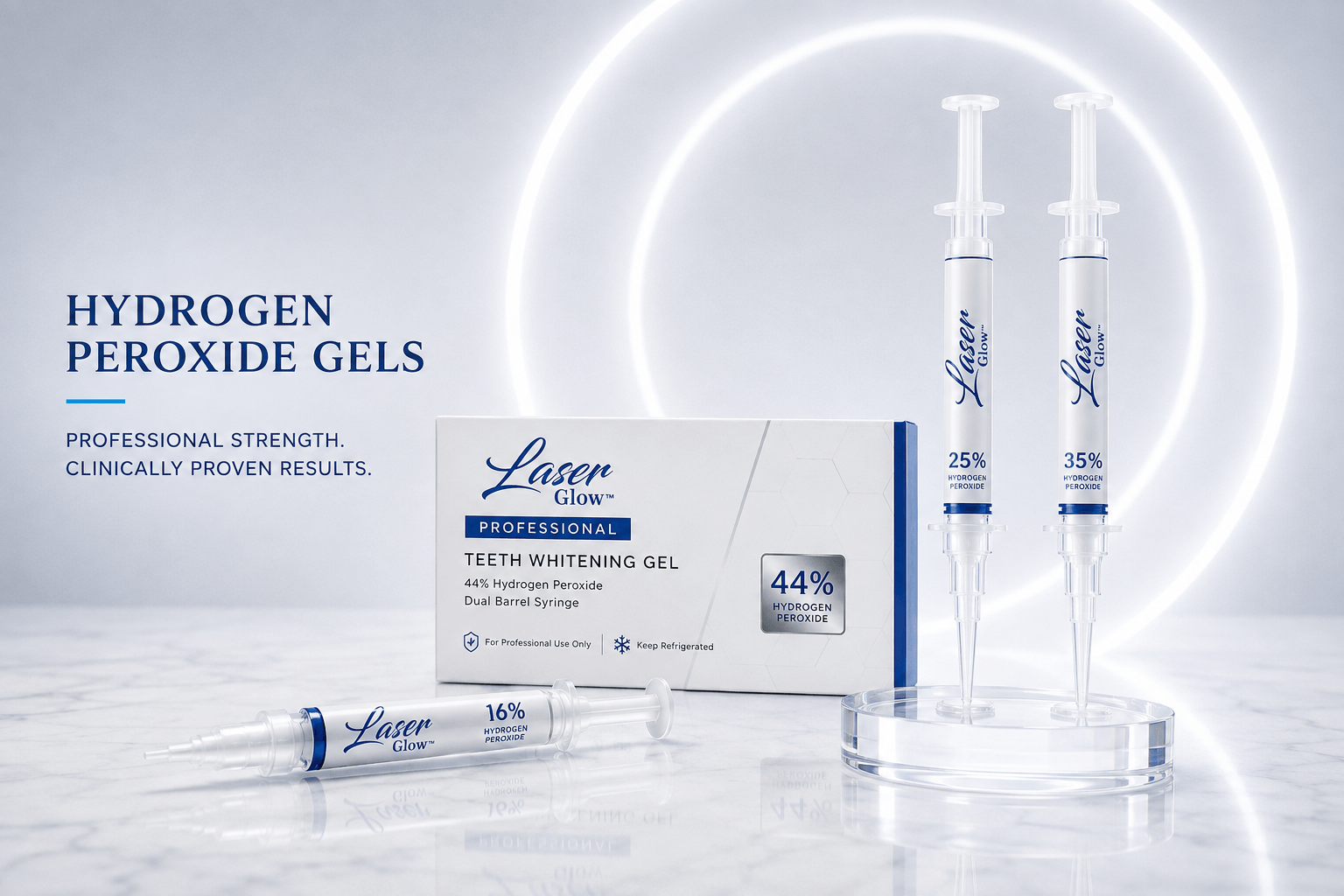
16%, 25% and 35% single syringes; 36% and 44% dual-barrel. Professional use only.
Teeth whitening gel collection →Is PAP+ the same across every brand?
No. “PAP+” describes different finished formulations and supporting ingredients depending on the manufacturer. Evaluate the exact label, substantiation and instructions for the product you are considering.
For LaserGlow’s formula, see the 12% PAP+ professional guide.
Is carbamide peroxide weaker than hydrogen peroxide?
The same stated percentage does not represent the same immediate hydrogen peroxide concentration, and the two agents have different release profiles. Compare finished products and intended use, not label numbers alone.
The full two-agent breakdown is in our carbamide peroxide vs hydrogen peroxide guide.
Is PAP as good as peroxide for professional whitening?
It depends on the goal. PAP+ and hydrogen peroxide play different roles, and the evidence base for PAP+ is less mature and less standardized than for peroxide.
We answer the strength question directly in is PAP as good as peroxide?
Is peroxide whitening unsafe?
Peroxide whitening has a substantial evidence base, but temporary tooth sensitivity and gingival irritation can occur. Appropriate client assessment, isolation and use according to the product instructions matter.
Review teeth whitening safety and compliance before you build a protocol.
Does peroxide-free mean sensitivity-free?
No. “Peroxide-free” describes the active system. Some clients can still experience sensitivity or irritation with a PAP+ formula.
See teeth whitening for sensitive teeth for planning options.
Which chemistry whitens crowns or veneers?
None. Whitening agents do not change crowns, veneers, bonding or tooth-colored fillings the way they change natural teeth. Discuss possible shade mismatch before whitening.
More detail: whitening with crowns, veneers or braces.
Picked a chemistry? Choose the product.
Shop professional hydrogen peroxide gels from 16% to 44%, or the peroxide-free 12% PAP+ gel. For trained providers. Follow product instructions and confirm the rules in your state.