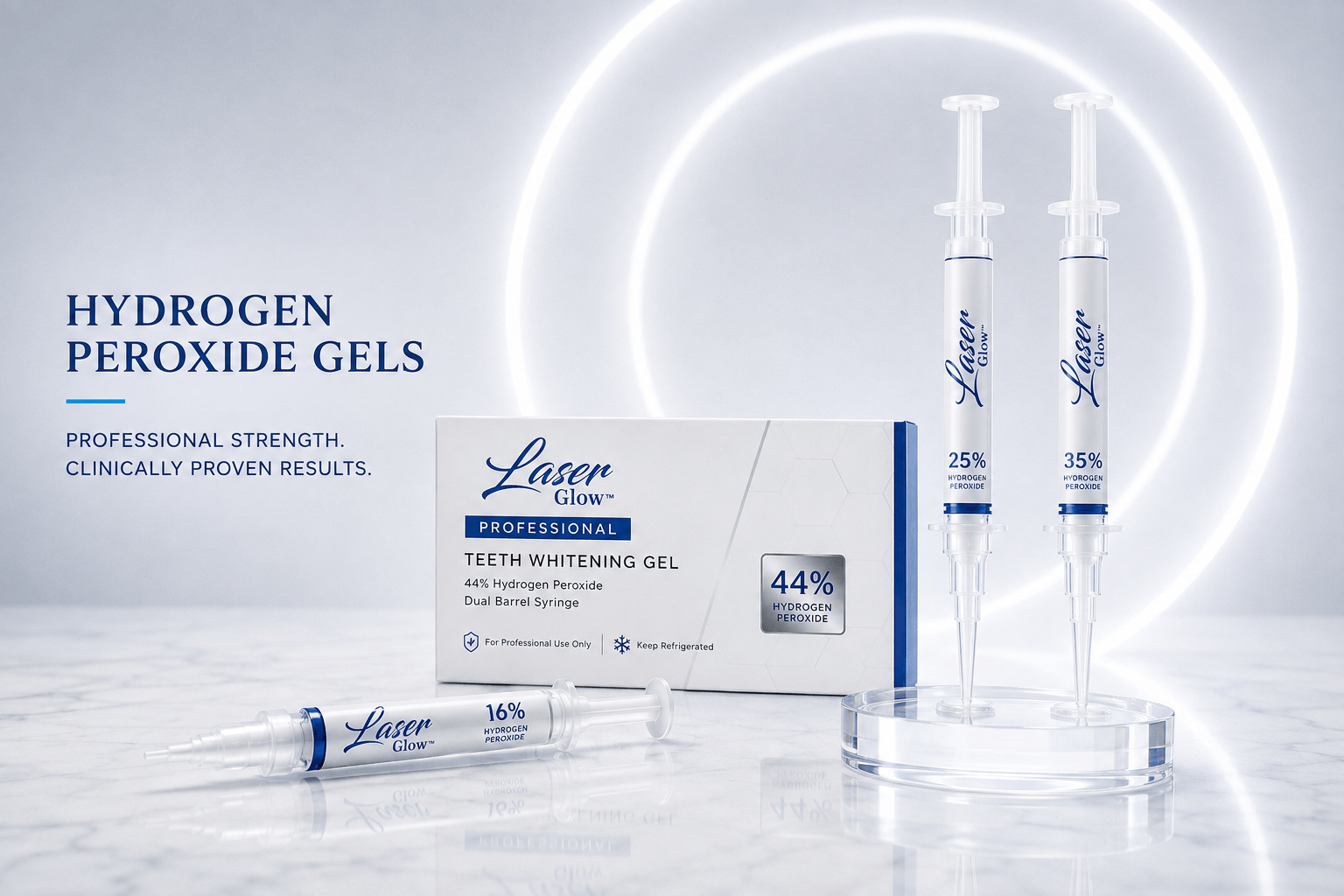
Hydrogen peroxide and carbamide peroxide are established whitening agents, but they are not interchangeable percentages. This guide focuses only on their chemistry, release profile, evidence, and treatment-setting considerations.
What Is the Difference Between Hydrogen Peroxide and Carbamide Peroxide?
Hydrogen peroxide is the directly active bleaching agent. Carbamide peroxide breaks down into hydrogen peroxide and urea, creating a slower-release system. That difference affects concentration interpretation and how specific products are formulated and instructed for use. Neither agent is universally "better"; select the finished product and protocol according to its directions, evidence, client factors, provider role, and treatment setting.
HP vs. CP Comparison
| Factor | Hydrogen peroxide | Carbamide peroxide |
|---|---|---|
| Chemistry | Direct source of hydrogen peroxide. | Releases hydrogen peroxide as the carbamide compound breaks down. |
| Release profile | Generally faster acting once applied. | Generally slower, more extended release. |
| Percentage labels | States the HP concentration in that product. | States the CP concentration; it is not equivalent to the same percentage of HP. |
| Common positioning | Used in various in-office and at-home products depending on concentration and instructions. | Common in dentist-supervised take-home tray products and other extended-contact formats; some in-office products also exist. |
| Sensitivity and irritation | Both can cause temporary sensitivity and gingival irritation. Risk depends on concentration, contact time, application, individual factors, and product instructions. | |
| Restorations | Neither whitens tooth-colored restorations such as crowns, veneers, fillings, or bonding. | |
How Should Professionals Choose Between HP and CP?
- Start with the finished product—not ingredient shorthand. Review intended use, instructions, concentration, pH, delivery system, contact time, storage, and contraindications.
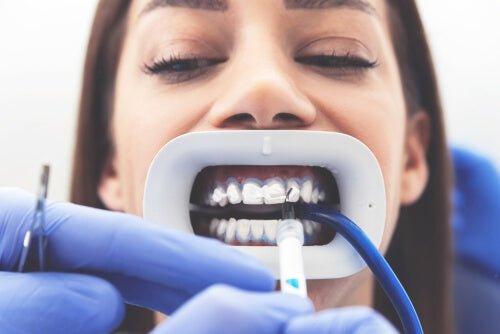
- Match the treatment setting. A chairside appointment and an extended take-home program require different controls and client behaviors.
- Assess sensitivity and soft tissue. The ADA identifies temporary tooth sensitivity and gingival inflammation as common adverse effects of whitening.
- Set restorative expectations. Natural teeth may lighten while visible restorations remain unchanged.
- Stay within scope. Use only products and procedures permitted for the provider and jurisdiction.
A 2024 systematic review found limited evidence that a particular in-office CP protocol may have similar efficacy and less sensitivity than a compared HP protocol, but the authors called for better trials. That evidence does not justify treating all CP and HP products as equivalent.
Why Percentage Alone Is Misleading
The same number on an HP and CP label does not represent the same immediate hydrogen-peroxide concentration. Simple conversion rules can be useful for understanding chemistry, but product selection should not be based on a homemade equivalence calculation. Formula, intended use, release pattern, contact time, and instructions still control how the product is used.
For a broader decision that includes peroxide-free PAP+, use the HP vs. CP vs. PAP+ professional comparison.
Hydrogen Peroxide vs. Carbamide Peroxide FAQs
Is carbamide peroxide weaker than hydrogen peroxide?
The percentages cannot be compared directly. CP releases HP over time, so use the finished product's instructions and evidence rather than choosing by the largest label number.
Which ingredient works faster?
Hydrogen peroxide is directly active, while carbamide peroxide releases it gradually. Actual performance depends on the complete product and protocol.
Which causes less sensitivity?
Both may cause sensitivity. Concentration, contact time, product, individual factors, and application matter. Evidence does not support a universal sensitivity guarantee for either agent.
Can HP and CP whiten crowns or veneers?
No. Whitening treatments affect natural teeth, not tooth-colored restorations.
Can the same percentage of HP and CP be substituted?
No. They represent different chemistries and release profiles. Never substitute products or timing outside their instructions.
Is carbamide peroxide the same as hydrogen peroxide?
No — carbamide peroxide is a precursor that breaks down into hydrogen peroxide and urea in the presence of water, releasing HP gradually rather than acting as the direct agent itself.
Can hydrogen peroxide and carbamide peroxide be mixed?
Providers should not combine agents outside a product's tested formulation or manufacturer instructions — follow the specific product's protocol rather than mixing whitening agents.