The dual-barrel format is a real clinical upgrade at 44% HP — not just packaging. But it's not the right choice for every service or every provider. Here's the actual case for each format and where the distinction matters most.
What Dual-Barrel Actually Changes About Whitening Gel
The marketing version of dual-barrel whitening gel leads with "maximum potency at application." That's accurate — but it's worth understanding exactly why it's true and when that advantage is clinically meaningful versus when it's irrelevant.
Hydrogen peroxide whitening gels are inherently unstable — once mixed, the active oxidizing chemistry begins degrading. A single-barrel pre-mixed gel is at peak potency immediately after manufacturing, and it degrades from there. By the time it's been packaged, shipped, stored, and applied to a client's teeth, some portion of the active HP has already been spent.
The dual-barrel system delays this. The two components — the HP gel and the activating agent — stay isolated in separate chambers until the syringe is expressed. At the moment of expression, they mix at the tip and exit as a freshly activated gel. The degradation clock starts when the components combine, which is at application rather than at manufacturing.
What Changes in the Chairside Workflow
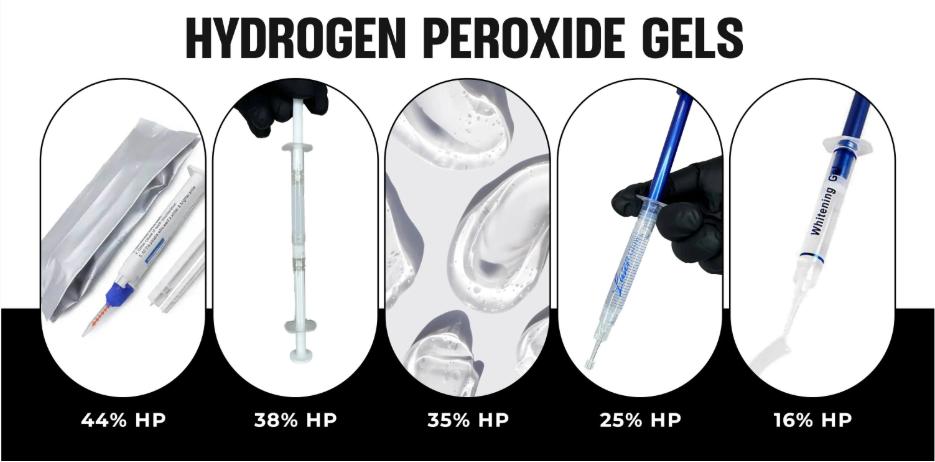
Single-barrel workflow (16%, 25%, 35% HP)
- Remove cap from syringe tip
- Apply gel directly to tooth surfaces
- Recap between rounds to prevent open-time degradation
- No tip attachment, no purge step
- Zero tip waste in the cost model
Dual-barrel workflow (36%, 44% HP)
- Attach mixing tip to dual-barrel syringe
- Express 0.1–0.2 mL to purge tip and confirm both barrels are flowing (discard this volume)
- Apply gel — freshly mixed at maximum potency
- Leave tip attached between rounds within the same session; remove and discard after session
- One tip per syringe; account for tip cost in per-session expense model
The Honest Recommendation
Use dual-barrel when:
- The case warrants 36% or 44% HP concentration
- Maximum potency at placement is clinically meaningful for the case type
- The provider is experienced with dual-barrel tip protocol
- You're running advanced or premium-tier whitening services
- Client has stubborn intrinsic or deep extrinsic staining
Single-barrel is the right call when:
- The case is routine — most chairside whitening is routine
- The concentration is 25% HP or below
- The provider is new to professional whitening
- You want the simplest consistent workflow at volume
- Margin sensitivity makes tip waste a meaningful consideration
The practical recommendation: build your core service around 25% HP single-barrel, stock dual-barrel 44% HP for advanced cases, and step providers into dual-barrel format only after they've run 20+ sessions with single-barrel and have isolation protocol dialed in.
Single & Dual-Barrel Gels by Concentration
Dual-Barrel Whitening Gel FAQ
Is dual-barrel whitening gel better than single-syringe?
At higher concentrations (36%, 44% HP), yes — the fresh-mix delivery preserves potency until application in a way that's clinically meaningful at those concentrations. At standard concentrations (25% HP), single-barrel performs consistently and the additional cost and workflow of dual-barrel isn't justified. "Better" depends on what concentration and case type you're working with.
What does the mixing tip do in a dual-barrel gel?
The mixing tip creates a controlled mixing channel where the two components from the dual-barrel syringe combine as they're expressed. The spiral design inside the tip mixes the components as they flow through, producing a uniform, freshly activated gel at the output end. Without the mixing tip, the two components would exit separately and unmixed — they need the tip's internal geometry to combine properly.
What happens if I forget to purge the dual-barrel tip before applying?
Skipping the purge means the first gel expressed from the tip may be one component without the other — not fully mixed. This can result in uneven activation across the first fraction of gel expressed. The purge ensures both barrels are flowing and the mixing is complete before any gel contacts the tooth surface. It's 10 seconds and 0.15 mL of gel — always purge.