How to Choose a Hydrogen Peroxide Whitening Gel Strength
Professional whitening gels · Gel selection for providers
How to Choose a Hydrogen Peroxide Whitening Gel Strength: 16%, 25%, 35%, 36% & 44% compared
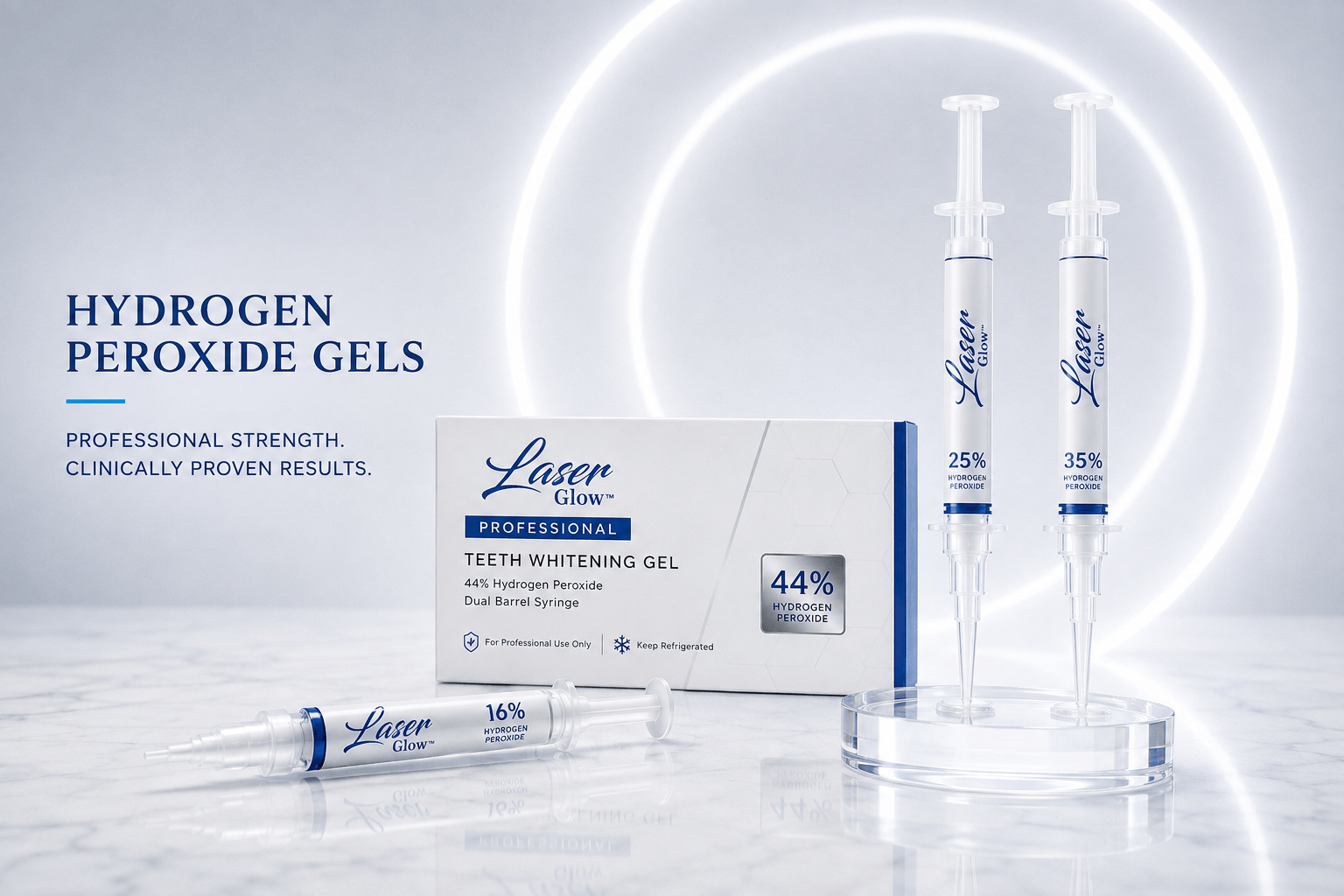
Five hydrogen peroxide whitening gel strengths, one decision: which one fits your client, your protocol and your experience level. This guide compares 16%, 25%, 35%, 36% and 44% HP side by side, explains how to match strength to the case, then links to the protocol guide and product for the strength you choose. A gingival barrier is required with every LaserGlow professional hydrogen peroxide gel.
- Five HP strengths: 16% to 44%
- 16%, 25%, 35%: 1.2 mL syringes
- 36% and 44%: dual-barrel
- Barrier required with every gel
Side by side
16 vs 25 vs 35 vs 44 hydrogen peroxide: strength comparison
The right whitening gel percentage depends on stain type, client sensitivity, your experience level and the outcome you are targeting. Use this table to match hydrogen peroxide whitening gel strength to case type, then open the protocol guide for the strength you pick.
| Strength | Best for | Sensitivity level | Format | Gingival barrier | Clients per syringe |
|---|---|---|---|---|---|
| 16% HP | First-time clients, sensitivity-prone clients, lighter staining | Low | 1.2 mL single syringe | Required | Up to 2 |
| 25% HP | Routine chairside whitening, most client types | Moderate | 1.2 mL single syringe | Required | Up to 2 |
| 35% HP | Stubborn staining, experienced providers, advanced cases | Moderate–high | 1.2 mL single syringe | Mandatory | Up to 2 |
| 36% HP | Advanced cases, fresh-mix precision workflows | Moderate–high | 1.2 mL dual-barrel | Mandatory | Up to 2 |
| 44% HP | Complex cases, intrinsic staining, experienced providers | High | 5 mL dual-barrel | Mandatory | Up to 3 |
Professional use only. Every LaserGlow professional hydrogen peroxide gel requires soft-tissue isolation with a gingival barrier (16%–44%), and the barrier is mandatory at 35% and above. These gels are for trained providers following a complete whitening protocol and product instructions. Not for consumer use. Yield assumes controlled application; actual yield depends on application thickness and arch coverage.
Selection criteria
Which whitening gel strength to use: four deciding factors
Higher is not automatically better. Choose the lowest strength that can realistically reach the client's goal with the isolation and experience you have.
-
01
Client sensitivity
First-time and sensitivity-prone clients start at 16%. Clients without significant sensitivity are usually well served by 25%.
-
02
Stain type
Lighter and moderate extrinsic staining responds to 16% or 25%. Stubborn and intrinsic staining is where 35%, 36% and 44% are considered.
-
03
Provider experience and isolation
The stronger the gel, the less margin for error in barrier placement. Reserve 35% and above for providers with an established isolation protocol.
-
04
Target outcome
A comfortable 16% first visit builds trust before a stronger session. Clients who want a bigger single-session change move up once screening supports it.
Default recommendation: for most med spas, salons and whitening studios running routine services, 25% HP is the starting point. It is strong enough for visible results and manageable for a wide range of clients. Prefer a printable version? Use the whitening gel selection checklist.
Each strength
Hydrogen peroxide whitening gel strength by case
Each strength has its own provider protocol guide covering screening, isolation, timing and aftercare, plus a product page when you are ready to order.
-
16%
16% HP: gentle entry strength
Lowest sensitivity in the line. For first-time clients, sensitivity-prone clients and maintenance visits.
-
25%
25% HP: the workhorse
Balanced strength for routine chairside whitening across most client types. The gel most services are built around.
-
35%
35% HP: advanced single syringe
For stubborn staining. Barrier mandatory; for trained providers with a proper isolation protocol.
-
36%
36% HP: fresh-mix dual-barrel
Components mix at the tip and activate at placement. An advanced professional workflow.
-
44%
44% HP: maximum strength
Dual-barrel 5 mL format for complex cases and experienced providers. Barrier mandatory.
Considering a peroxide-free option for some clients? Compare PAP vs peroxide whitening.
16%, 25% & 35%
Single 1.2 mL syringe
LaserGlow 16%, 25% and 35% HP syringes are 1.2 mL and treat up to 2 clients with controlled application. Applying more gel than needed reduces yield and raises per-client cost without improving results.
- Thin, even layer on the facial surfaces
- Track product use per appointment
- Yield depends on thickness and arch coverage
36% & 44%
Dual-barrel syringe
A dual-barrel gel keeps separate components apart in a two-chamber syringe until application. When the syringe is expressed, the components mix at the tip and activate right at placement, preserving the active concentration until it is needed. That matters most at 36% and 44%. The 44% dual-barrel syringe is 5 mL and treats up to 3 clients.
Dual-barrel vs single-syringe whitening gel →Who uses LaserGlow pro gels
Built for professional whitening providers
Whether you run a single-chair salon or a multi-location practice, these gels are designed around chairside workflow. Confirm the rules in your state for your provider type before offering the service.
Dentists & hygienists
In-office chairside whitening with professional HP gel and complete soft-tissue protection.
Safety & compliance →Med spas & aesthetic clinics
A premium add-on with documented protocol, client screening and the isolation each strength requires.
Gels for med spas →Salons & beauty pros
The right gel strength for the skill level and service menu, where state rules allow.
Isolation protocols →Whitening technicians
Dedicated studios that need reliable gel yield and consistent results.
Cost per client →Buying at volume for multiple locations or resale? See wholesale teeth whitening gel. Want your own branded line? Read the private label teeth whitening guide.
Essential supplies
Complete your chairside setup
Gel is only part of a professional whitening service. These supplies pair with every HP gel in the LaserGlow line.
FAQ
Professional whitening gel FAQ
Questions providers ask before choosing a strength. Still unsure? Contact our pro team.
What is the best professional teeth whitening gel concentration?
It depends on the case: 25% HP is the most commonly used chairside strength for routine whitening, 16% suits sensitivity-prone clients and new providers, and 35% to 44% are reserved for stubborn staining and complex cases with proper isolation.
For most med spas, salons and whitening studios running routine services, 25% HP is the starting recommendation. Work through the whitening gel selection checklist for the full criteria.
Do I need a gingival barrier with professional whitening gel?
Yes. A gingival barrier is required with every LaserGlow professional hydrogen peroxide gel (16%–44%) and is mandatory at 35% and above.
Follow the whitening gel and barrier product instructions for placement, curing and coverage checks before gel application. See soft tissue isolation for teeth whitening.
How many clients can one syringe of whitening gel treat?
LaserGlow 16%, 25% and 35% HP syringes are 1.2 mL and treat up to 2 clients with controlled application; the 44% HP dual-barrel syringe is 5 mL and treats up to 3 clients.
Actual yield depends on application thickness, arch coverage and whether you treat both arches in a session.
What is the difference between hydrogen peroxide and carbamide peroxide for whitening?
Hydrogen peroxide is the faster-acting of the two; carbamide peroxide breaks down into hydrogen peroxide over time, with roughly one-third of its concentration becoming active HP.
A 36% carbamide peroxide gel contains roughly 12% active hydrogen peroxide. HP is preferred for chairside whitening, while carbamide peroxide is more common for extended home tray whitening because its slower release is more tolerable. Full comparison: carbamide peroxide vs hydrogen peroxide.
How do you reduce the risks of professional whitening gel?
Use it only as a trained provider following a complete protocol: proper client screening, correct strength selection, full gingival barrier placement, controlled application timing and aftercare.
Risks increase when protocol steps are skipped, when strength is mismatched to the case, or when isolation is inadequate. See teeth whitening safety and compliance and does teeth whitening damage enamel?
What is a dual-barrel whitening gel?
A dual-barrel gel keeps separate components apart in a two-chamber syringe until application, then mixes them at the tip so the gel activates right at placement.
This preserves the active HP concentration until it is needed, which is especially valuable at 36% and 44%.
Does leaving whitening gel on longer improve results?
Not reliably. Results depend mainly on gel concentration, application quality, isolation and case selection, not on extending contact time beyond the recommended protocol.
Leaving gel on longer than indicated can increase sensitivity and gum irritation without proportionally better whitening. Full explanation: does leaving whitening gel on longer work?
Can I use professional whitening gel on clients with veneers or crowns?
You can whiten the natural teeth, but hydrogen peroxide gel does not change the shade of porcelain veneers, crowns, bonding or other restorations.
Whitening around existing restorations can create a shade mismatch as the natural teeth lighten, so screen for restorations and discuss it before treatment. See troubleshooting whitening results.
Chosen your strength?
Shop the full professional range from 16% to 44% HP, or go back to the professional teeth whitening guide for setup, protocol and pricing.