Teeth Whitening Questions Answered
Everything you need to know about teeth whitening — how it works, safety, sensitivity, professional gel selection, at-home options, and who the right candidates are. Covering both consumer products and professional-grade supplies used by dental offices, med spas, and whitening studios.
50+ questions answered
9 topic categories
Professional & consumer coverage
Reviewed by David Hanna, RDH
How Teeth Whitening Works
6 Questions
Teeth whitening is a cosmetic process that lightens the natural color of tooth enamel by breaking down stain-causing molecules embedded in or on the tooth surface. Most professional whitening systems use hydrogen peroxide or carbamide peroxide as the active bleaching agent, applied directly during a chairside or at-home treatment. Results depend on starting shade, stain type, gel concentration, and exposure time.
Hydrogen peroxide releases free oxygen radicals when it contacts tooth enamel. These radicals penetrate the enamel surface and break apart the carbon bonds in chromogen molecules — the compounds responsible for tooth discoloration. The result is a lighter shade of enamel without removing any tooth structure. This process is temporary in the sense that re-staining can occur over time with normal diet and lifestyle.
Hydrogen peroxide (HP) is the active bleaching agent in both types of gel. Carbamide peroxide breaks down into hydrogen peroxide and urea when it contacts moisture — roughly one-third of carbamide peroxide converts to active hydrogen peroxide. HP gel delivers immediate, fast-acting results and is the standard for professional chairside whitening. Carbamide peroxide releases more slowly, making it better suited for extended tray-based treatments or at-home applications where longer contact time is acceptable.
LED and laser lights are used to activate or accelerate whitening gel during in-office treatments. The light energy helps initiate the breakdown of hydrogen peroxide faster than it would occur at body temperature alone, supporting more efficient gel activation during the treatment window. Not all whitening gels require light activation, but light-compatible formulas tend to deliver faster and more consistent results in shorter chair time when used with a professional-grade LED or laser whitening machine.
PAP stands for Phthalimidoperoxycaproic Acid — a peroxide-free whitening agent that targets and dissolves surface stains without releasing free radicals the way hydrogen peroxide does. PAP whitening is generally better tolerated by people with sensitivity and is safe for use on dental restorations including veneers and crowns. It does not deliver the same depth of shade change as peroxide-based gels for heavily stained teeth, but is effective for surface stain removal and daily whitening maintenance.
Purple toothpaste uses violet pigment technology based on color theory — purple sits opposite yellow on the color wheel, so applying a violet pigment to yellow-toned teeth creates an optical neutralizing effect that makes teeth appear whiter immediately. This is cosmetic brightening, not chemical bleaching. The effect washes off after eating or drinking and does not change the underlying shade of enamel. Best used as a daily brightening step or for photos and events, not as a replacement for whitening treatment.
Professional Whitening Gels — Multiple Strengths
16%–44% hydrogen peroxide gels for dental offices, med spas, and whitening studios.
Safety & Sensitivity
9 Questions
Professional teeth whitening using hydrogen peroxide or carbamide peroxide at recommended concentrations and exposure times does not remove enamel or permanently damage tooth structure when used as directed. The whitening process penetrates enamel temporarily and can cause transient sensitivity, but does not cause enamel erosion. Following proper protocols — including correct exposure time, gingival isolation, and appropriate gel strength selection — is essential for safe outcomes.
Whitening-related sensitivity occurs because hydrogen peroxide can temporarily increase the permeability of enamel, allowing thermal and tactile stimuli to reach the dentin and pulp more easily. This effect is usually temporary and resolves within 24–48 hours after treatment. Using a desensitizing gel before or after whitening, selecting a lower peroxide concentration, or shortening exposure time can all help manage post-whitening sensitivity.
People with naturally sensitive teeth can whiten safely with the right approach. Lower-strength gels (16% HP or peroxide-free PAP), shorter application times, and pre-treatment desensitizing gel are all effective strategies for reducing sensitivity during whitening. Clients with significant sensitivity should inform their provider before treatment so the protocol can be adjusted. A peroxide-free PAP formula is the best option for those with extreme sensitivity.
Professional dental guidelines generally recommend avoiding teeth whitening during pregnancy as a precaution. There is no definitive evidence that whitening causes harm, but systemic absorption of whitening agents during pregnancy has not been studied extensively enough to establish safety. The standard recommendation is to postpone elective whitening until after pregnancy and breastfeeding.
For most people, one to two professional whitening sessions per year is sufficient to maintain results without overexposure. Daily whitening toothpastes, purple color correctors, and maintenance gels can be used more frequently for surface stain management. Whitening too frequently with high-strength peroxide without adequate recovery intervals can increase sensitivity and temporarily affect enamel integrity. Always follow the recommended protocol intervals for the gel strength being used.
Whitening gel that contacts gum tissue can cause temporary irritation, blanching, or sensitivity. This is why gingival barrier gel is required when using 35% or higher hydrogen peroxide concentrations. Proper soft tissue isolation using retractors, cotton rolls, and a light-cured gingival barrier protects the gums during chairside whitening and prevents high-strength peroxide from contacting soft tissue. When proper isolation protocols are followed, gum damage from whitening is rare.
Long-term use of teeth whitening products at appropriate concentrations and intervals is not associated with permanent enamel damage in the clinical literature. The key variables are gel concentration, exposure time, and frequency. Overuse of high-strength peroxide at short intervals can cause increased sensitivity and surface changes. Following professional protocols and allowing adequate recovery time between sessions supports long-term enamel health and consistent whitening results over time.
Whitening itself is not painful, but many people notice temporary sensitivity to cold, heat, or pressure during or shortly after treatment. This is a normal response to hydrogen peroxide temporarily increasing enamel permeability, not a sign of damage, and it typically resolves within 24–48 hours. Choosing a lower peroxide concentration, shortening exposure time, or using a desensitizing gel beforehand can all help minimize discomfort for sensitivity-prone clients.
The most common side effects are temporary tooth sensitivity to hot, cold, or pressure, and mild gum irritation if whitening gel contacts soft tissue. Both are typically short-lived and resolve within a day or two. Following proper protocols — correct gel strength, exposure time, and gingival isolation where required — significantly reduces the likelihood and severity of these effects. Whitening is not associated with permanent enamel damage when performed as directed.
Results & Expectations
6 Questions
Results vary significantly based on starting shade, stain type, enamel condition, and the whitening system used. Most clients achieve between 2 and 8 shade improvements with a single professional in-office session. Intrinsic staining from medications, fluorosis, or aging may respond less dramatically than extrinsic staining from food, drink, and tobacco. A realistic expectation for in-office whitening is visible, noticeable brightening — individual results vary and are not guaranteed to reach a specific shade.
In-office whitening results typically last between 6 months and 2 years depending on diet, oral hygiene, and lifestyle factors. Coffee, tea, red wine, and tobacco are the primary contributors to re-staining. Using a whitening toothpaste, avoiding heavy stain-causing foods immediately after treatment, and scheduling periodic touch-up sessions extends results. At-home maintenance with a lower-concentration gel can help preserve in-office results between professional appointments.
Several factors can limit whitening response. Intrinsic stains — embedded within the dentin rather than on the enamel surface — are significantly harder to whiten than surface (extrinsic) stains. Tetracycline staining, dental fluorosis, and age-related yellowing from dentin thickening often require extended treatment or may not respond fully to standard whitening. If teeth are not responding to standard gel concentration, a higher-strength protocol or extended exposure may be appropriate under professional supervision.
Yellow-toned teeth typically respond best to hydrogen peroxide whitening. Grey, blue-grey, or brown discoloration — particularly from tetracycline antibiotics taken during tooth development — is more resistant to peroxide whitening and may require multiple extended sessions or alternative cosmetic solutions. Brown staining from tobacco, coffee, or tea tends to respond better to whitening than grey internal staining, which originates within the dentin rather than on the enamel surface.
Tooth staining falls into two categories. Extrinsic staining occurs on the enamel surface from food, drink, and tobacco — coffee, tea, red wine, berries, and tobacco are the most common culprits. Intrinsic staining occurs within the tooth structure itself, from factors including tetracycline use during tooth development, dental fluorosis, trauma, aging, or excessive fluoride exposure during enamel formation. Extrinsic stains respond well to whitening. Intrinsic stains are more difficult to treat and may require higher-strength protocols or cosmetic restorations for predictable results.
For the first 24–48 hours after whitening, enamel is more porous and temporarily more susceptible to staining. It's best to avoid coffee, tea, red wine, dark sodas, berries, tomato sauce, and tobacco during this window, and to follow a light-colored "white diet" where possible. Returning to normal eating and drinking habits after this period is fine, though limiting heavy stain-causing foods and drinks long-term will help results last longer between sessions.
Professional vs. At-Home Whitening
6 Questions
Professional whitening uses significantly higher concentrations of hydrogen peroxide (16%–44%) applied chairside under controlled conditions with gingival isolation and professional supervision. At-home systems use lower concentrations applied via trays, strips, or pens without direct professional oversight. Professional whitening delivers faster, more dramatic results in a single session. At-home systems work gradually and are better suited for maintenance or mild staining. The level of isolation, monitoring, and protocol control also differs significantly between the two settings.
For clients who want immediate, visible results in a single visit — before an event, wedding, or photoshoot — in-office whitening offers something at-home products cannot: controlled, professional-strength treatment in one to two hours. The results are faster and typically more pronounced than extended at-home use. For ongoing maintenance between professional sessions, at-home products are a practical and cost-effective option.
A professional in-office whitening session takes under an hour; LaserGlow’s Platinum 1-Hour Whitening takes about 50 minutes. This includes preparation (gingival isolation, barrier application), one to three 15-minute gel application passes, and post-treatment evaluation. Some providers offer shorter express or refresh sessions of 20–30 minutes using a single gel pass for maintenance appointments. LaserGlow in-office locations offer the Platinum 1-Hour Whitening and a Refresh treatment for returning clients.
Chairside whitening refers to any professional whitening treatment performed in a clinical setting with the client in a treatment chair. The provider applies whitening gel directly to the teeth, manages soft tissue isolation and exposure time, and may use LED or laser activation equipment. Chairside whitening is performed by dentists, dental hygienists, whitening technicians, med spa providers, and licensed estheticians depending on local scope of practice regulations.
At-home systems using professional-strength carbamide peroxide in tray or LED delivery systems can produce significant whitening results over multiple sessions, but they require consistent daily use over days or weeks rather than delivering immediate single-session results. LaserGlow's Wireless LED Whitening Kit with 44% CP gel is designed to deliver stronger-than-strip results for clients who prefer to whiten at home on their own schedule.
In-office professional whitening typically ranges from $150 to $299 per session depending on the provider, treatment length, and gel strength used. LaserGlow's own Platinum 1-Hour Whitening and Refresh Whitening treatments fall within this range — pricing is listed on each location page. At-home professional-strength options, like a wireless LED kit or a whitening pen, generally cost less per use and work well for maintenance between in-office visits. Cost varies by provider, so always confirm pricing directly before booking.
In-Office Whitening — Clifton, Edgewater & Miami
Book a Platinum 1-Hour Whitening or Refresh treatment at a LaserGlow location near you.
Professional Whitening Gels
7 Questions
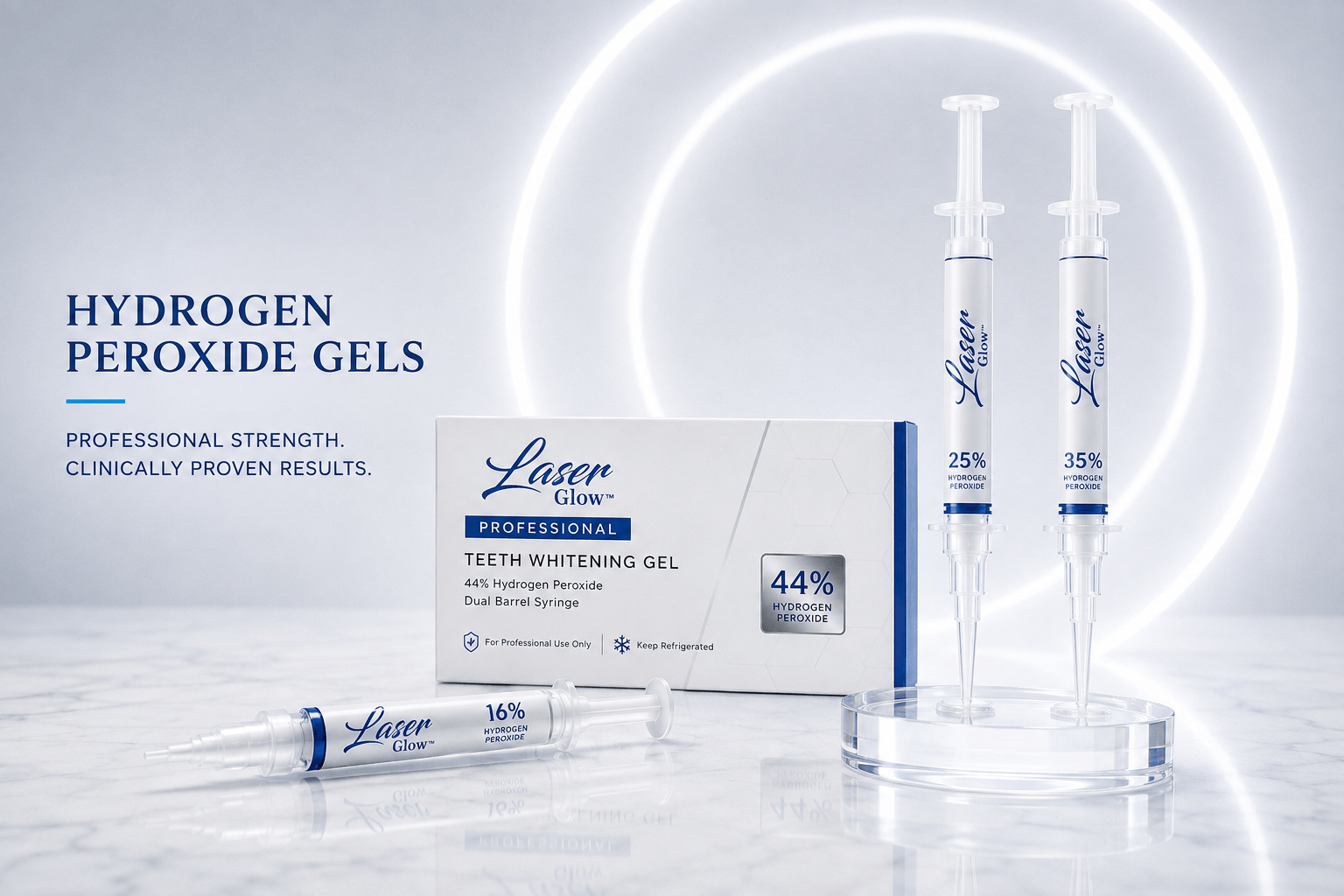
Professional in-office whitening uses hydrogen peroxide concentrations ranging from 16% to 44%, depending on the provider's protocol, client sensitivity profile, and desired treatment speed. 16% HP is a lower-sensitivity option for new-to-whitening clients. 25% and 35% are standard to high-strength chairside options. 44% HP dual-barrel gel is maximum-strength professional whitening for cases requiring fast, dramatic shade improvement with efficient chair time. Use a gingival barrier with every professional gel; it is mandatory at 35% and above.
LaserGlow 44% HP dual-barrel gel is the highest-concentration professional whitening gel in the LaserGlow line. It is designed for professional chairside use in cases requiring fast or dramatic shade improvement — heavy staining, event-ready results, or clients who have plateaued with lower concentrations. The dual-barrel fresh-mix syringe keeps peroxide and activator separated until dispensed, ensuring maximum potency at point of application. Gingival barrier required. For professional use only by trained providers.
Both are professional-strength gels requiring proper isolation and training. 35% HP is a proven standard-strength option used widely across dental offices and whitening studios for effective chairside whitening with a slightly lower intensity profile. 44% HP is selected for cases requiring faster or more dramatic shade improvement — heavy staining, time-sensitive goals, or clients who have plateaued with 35% or lower. Both require a gingival barrier and strict adherence to professional protocols.
LaserGlow 16% HP gel is the right choice for clients new to whitening, those with a history of sensitivity, or cases where a gentler introduction to chairside whitening is appropriate. LaserGlow 25% HP is a reliable mid-strength option for standard in-office whitening cases where balancing efficacy with sensitivity management is the priority. It is widely used across professional whitening studios and med spas for everyday chairside treatments.
A dual-barrel syringe holds two separate components — the hydrogen peroxide gel and the activator — in parallel chambers. When dispensed through the mixing tip, they combine at the moment of application, producing a freshly activated, fully potent whitening gel for every use. This design prevents premature activation, maintains gel stability during storage, and ensures consistent potency across multiple treatment passes from the same syringe. LaserGlow offers both 36% and 44% HP in the dual-barrel format.
A gingival barrier (also called a gum dam or gum protector) is a light-cured resin gel applied along the gum line before whitening to protect soft tissue from direct contact with hydrogen peroxide. It is required when using 35% or higher hydrogen peroxide concentrations, where unprotected gum exposure can cause significant irritation or chemical burn. The barrier is applied with precision along the gingival margin, cured with an LED curing light, and peeled away cleanly after treatment. LaserGlow Gingival Barrier Gel is formulated for professional whitening use.
Yield varies by syringe size and application technique. LaserGlow's 5 mL dual-barrel syringes (36% and 44% HP) yield up to 3 client treatments or approximately 9 whitening passes (3 x 15-minute applications per session). Smaller syringes in the 16%, 25%, and 35% HP range typically yield 2–4 applications depending on arch coverage and protocol. High-volume providers can access bulk whitening gel options and professional pricing through LaserGlow's wholesale supply channel.
Special Cases & Candidacy
6 Questions
No. Hydrogen peroxide and carbamide peroxide only affect natural tooth enamel. Dental restorations — including porcelain crowns, veneers, composite bonding, and implant crowns — do not change color in response to whitening. If you have visible restorations near the front teeth, whitening your natural teeth may create a visible color mismatch between treated natural enamel and unchanged restorations. Always disclose existing restorations to your whitening provider before beginning treatment.
Whitening with untreated cavities or active decay is not recommended. Hydrogen peroxide can penetrate through compromised enamel and reach the pulp, causing significant pain or sensitivity. All active dental issues should be treated before beginning any whitening protocol. A pre-whitening dental assessment is recommended, especially for first-time whitening clients with unknown dental history.
Professional whitening is generally not recommended for children under 14. Adolescents between 14 and 18 may be candidates for lower-concentration whitening under parental and dental supervision, as their pulp chambers are proportionally larger and more sensitive to whitening treatment. The decision should be made in consultation with a dentist who can assess dental maturity and individual suitability before beginning any whitening protocol.
Whitening with fixed metal or ceramic braces is not recommended. The brackets prevent gel from reaching the underlying enamel evenly, resulting in uneven whitening — protected spots under brackets remain the original shade while surrounding enamel lightens. Whitening should be deferred until after braces are removed. Clear aligner patients can whiten between aligner changes but should consult their orthodontist before starting any whitening protocol.
Mild to moderate dental fluorosis (white spots or light brown mottling) may respond partially to extended whitening treatment. Severe fluorosis and tetracycline staining are intrinsic and significantly harder to treat with peroxide alone. Tetracycline staining — grey, blue-grey, or brown banding within the dentin — may show limited improvement even with high-concentration professional whitening. In these cases, cosmetic restorations may deliver a more predictable and uniform result.
Whitening is not recommended for people who are pregnant or breastfeeding, individuals under 14 years old, patients with untreated cavities or active gum disease, people with known peroxide sensitivity or allergies, and those with primarily intrinsic staining unlikely to respond to peroxide treatment. Clients with significant visible restorations on front teeth should discuss expected outcomes with their provider before beginning whitening. A thorough intake and candidacy assessment is the most reliable way to set appropriate expectations and ensure safe treatment.
At-Home Whitening Products
6 Questions
Over-the-counter whitening strips typically use 6%–14% hydrogen peroxide and can produce gradual improvement in surface staining with consistent daily use over 2–4 weeks. They are not as effective as professional chairside whitening for deeper or more significant staining, and results are slower. They are a reasonable at-home maintenance option between professional treatments for those with mild surface staining and no significant sensitivity.
Most whitening toothpastes work through mild abrasives that polish and remove surface stains rather than chemically bleaching enamel. Some formulas contain low concentrations of hydrogen peroxide or PAP for added whitening effect. Whitening toothpastes can help maintain previous whitening results and reduce surface re-staining, but do not produce the same shade improvement as gel-based whitening systems. LaserGlow's flavored whitening toothpaste range is formulated with peroxide-free stain removal for safe daily use.
Purple toothpaste is used for instant optical brightening rather than chemical whitening. The violet pigment neutralizes yellow tones on the tooth surface using color theory — purple and yellow are complementary colors — making teeth appear cooler and brighter immediately after use. The effect washes off after eating or drinking and does not change the underlying shade of enamel. LaserGlow Purple Toothpaste Serum was named Best Purple Whitener of 2026 by Health.com and is designed as a daily cosmetic brightener or event-ready step, not a replacement for whitening treatment.
At-home LED whitening kits can support whitening results when paired with an effective whitening gel. The LED light does not whiten teeth on its own — it works in combination with a peroxide or PAP gel to support faster gel activation. The key variable is gel strength. Consumer LED kits with very low-concentration gel deliver modest results. LaserGlow's wireless LED kit pairs LED activation with a professional-strength 44% carbamide peroxide gel for a meaningfully stronger at-home result than standard strip or tray systems.
The most effective at-home whitening options use professional-strength carbamide peroxide in tray or LED delivery systems. LaserGlow's Wireless LED Teeth Whitening Kit with 44% CP gel delivers stronger-than-strip results at home with LED activation. For peroxide-free daily whitening, LaserGlow PAP+ Whitening Powder provides stain removal without sensitivity. For maintenance between professional sessions, the 44% CP Whitening Pen is a convenient daily-use option.
Natural approaches — brushing consistently, using a straw for staining drinks, and limiting coffee, tea, red wine, and tobacco — help slow new staining but do not chemically lighten enamel the way hydrogen peroxide or carbamide peroxide does. Common DIY methods like baking soda or lemon juice can be abrasive or acidic and are not recommended for regular use, since they can wear enamel over time. For a genuine shade change at home, a peroxide-free PAP formula or a professional-strength carbamide peroxide product is a safer and more effective starting point than DIY ingredients.
At-Home Whitening — Stronger Than Strips
Purple toothpaste, PAP+ powder, LED kits, and 44% CP gel for home whitening that actually works.
Starting a Teeth Whitening Business
5 Questions
Whether estheticians and salon professionals can legally offer teeth whitening depends on state and local regulations. In many states, teeth whitening by non-dental professionals is permitted when hydrogen peroxide concentrations are below a specified threshold, the service is marketed as cosmetic rather than dental, and certain scope of practice requirements are followed. Regulations vary significantly by jurisdiction. Anyone adding whitening to their service menu should review their specific state's rules before offering treatment.
A complete professional whitening setup requires a professional LED whitening machine, a selection of hydrogen peroxide gels (typically 16%–44%), gingival barrier gel, an LED curing light for the barrier, cheek retractors, suction tips, cotton rolls, and client disposables. LaserGlow's Whitening Business Starter Kit includes everything needed to run a complete chairside whitening service from the first appointment, including a professional LED whitening machine and basic PDF training resources.
Training requirements vary by state and provider type. Dental professionals receive whitening training as part of their clinical education. Non-dental professionals adding whitening services should complete a whitening-specific certification or training program covering protocols, safety, isolation techniques, gel selection, and contraindication screening. LaserGlow offers a professional Advanced Teeth Whitening Course covering clinical technique, sensitivity management, restorations, blistering, blanching, and common technique errors.
Gel selection is based on stain severity and type, client sensitivity history, available chair time, and desired treatment speed. Clients new to whitening or with reported sensitivity should start with 16% or 25% HP. Standard chairside cases use 25%–35% HP. Cases requiring fast, dramatic results — heavy staining, event preparation, or clients who have plateaued at lower concentrations — are candidates for 44% HP dual-barrel gel with proper gingival isolation. LaserGlow's professional gel selector tool can help guide the right choice by protocol.
Teeth whitening is one of the highest-margin cosmetic services a salon or studio can add. Most providers charge $150–$299 per whitening session with per-client gel costs typically between $8–$20. A single LaserGlow 5 mL dual-barrel syringe yields up to 3 client treatments. With 20–40 sessions per month, whitening can add $3,000–$8,000 or more in monthly revenue to an existing beauty practice. The initial equipment investment with a LaserGlow starter kit typically pays for itself within 5–10 clients.
Whitening Business Starter Kit — Everything in One Bundle
Machine, gels, supplies, and training included. Ship from the US. Ready from appointment one.
LaserGlow Products & Services
5 Questions
LaserGlow offers a complete professional hydrogen peroxide whitening gel line: 16% HP (low-sensitivity), 25% HP (standard professional), 35% HP (high-strength chairside), 36% HP Dual-Barrel, and 44% HP Dual-Barrel (maximum-strength). The line also includes Gingival Barrier Gel, Desensitizing Gel, and a 44% Carbamide Peroxide Whitening Pen for at-home use. All gels ship from the US with fast fulfillment for professional restocking.
LaserGlow's consumer whitening line includes the Purple Toothpaste Serum (Best Purple Whitener 2026, Health.com), PAP+ Whitening Powder (peroxide-free), Flavored Whitening Toothpaste, Wireless LED Teeth Whitening Kit with 44% CP gel, and a 44% Carbamide Peroxide Whitening Pen for daily maintenance. Oral care products including the Water Flosser, Sonic Electric Toothbrush, HA5 Mouthwash, and UV Toothbrush Sanitizer round out the full consumer line.
LaserGlow offers in-office laser teeth whitening at three locations: Clifton, New Jersey (1412 Main Ave); Edgewater, New Jersey (125 River Road Suite 105, inside Modern Aesthetics); and Miami, Florida on select dates. All NJ locations are open Saturday 9am–1pm and Sunday 12pm–4pm. For weekday hours, booking or current availability, call 862-400-7279 or visit the location page.
LaserGlow professional whitening gels are developed under the clinical direction of David Hanna, RDH, and are trusted by dental offices, med spas, whitening studios, and whitening technicians. The 44% HP dual-barrel gel is Amazon's Overall Pick for professional whitening with over 1,100 professional reviews including verified purchases from DDS and DMD providers. LaserGlow ships from the US and maintains consistent inventory for professional restocking.
Yes. LaserGlow offers wholesale and bulk pricing options for professional whitening supply buyers including dental offices, med spas, salons, and whitening studios. Visit the wholesale page or contact LaserGlow directly at support@laserglowspa.com or 862-400-7279 to discuss volume pricing and professional account setup.