LED teeth whitening looks like a passive process from the outside: gel goes on, light turns on, you sit still. But the outcome is determined by a set of active, controllable variables that most people don't think about until something goes wrong — the sensitivity was worse than expected, the results faded in two weeks, the at-home kit didn't do what the before-and-afters suggested it would. In every one of those cases, the problem wasn't the technology. It was a gap in information going in.
This guide covers the five variables that actually determine whether you walk away with a real, lasting result — or a same-shade smile and a sore mouth. Whether you're planning your first in-office session or you've already ordered an at-home kit, understanding the science and the protocol before you start is what separates good outcomes from frustrating ones.
The LED Light Activates the Gel — It Doesn't Whiten on Its Own
The most persistent misconception in LED whitening is that the light is doing the work. It isn't. The whitening is entirely performed by the active agent in the gel — hydrogen peroxide or carbamide peroxide — and understanding that distinction changes how you evaluate every kit, in-office treatment, and marketing claim in this category.
Here's the actual chemistry. Hydrogen peroxide is an unstable compound that breaks down into water and reactive oxygen species: free radicals small enough to penetrate the enamel structure and access the chromogen compounds embedded within it. Chromogens are the organic molecules responsible for staining and discoloration — what coffee, tea, red wine, and tobacco leave behind through years of contact with enamel. When the peroxide-derived free radicals reach those chromogen molecules, they break the molecular bonds responsible for color. That oxidation reaction is what whitening is.
The LED light's role is photocatalytic acceleration. A specific wavelength in the blue spectrum — typically in the 400 to 500 nanometer range — increases the rate at which the peroxide molecule decomposes into those reactive oxygen species. Faster decomposition means faster gel activation, better penetration depth into the enamel structure, and more consistent coverage across the entire treatment area versus a passive tray-only application over the same time window. It's why a professional in-office LED session can achieve in 45 to 60 minutes what a take-home tray might take a week of nightly applications to reach.
The practical implication worth holding onto: the gel does the actual whitening. A high-output LED paired with weak, under-concentrated, or expired gel is still producing a weak result — the light is just accelerating a failing reaction. What makes the LaserGlow LED Teeth Whitening Kit effective is that the gel concentration and LED wavelength are designed together as a matched system, not assembled from unrelated commodity components. The light emits at the activation wavelength the specific gel chemistry needs. The gel is formulated at the right concentration for safe, effective self-application. That combination is what separates a system from a product that's selling the aesthetic of the technology without the chemistry to back it up.
When evaluating any LED whitening kit: look for the stated hydrogen peroxide or carbamide peroxide concentration, the gel's shelf-life window, and the LED emission wavelength. If a product doesn't publish those details, it's marketing the light — not the chemistry behind it.
Your Starting Shade and Dental History Set Your Ceiling
Whitening is not a paint-over. It's a chemical reaction that targets specific compounds in or on your enamel structure — which means your result is bounded by what's actually present and reachable. Two people using the same kit at the same concentration for the same number of sessions can end up with meaningfully different outcomes, because the variables driving those outcomes aren't the product — they're the teeth. Understanding your own baseline before you start is how you set accurate expectations instead of avoidable disappointment.
Stain type is the first variable. Extrinsic staining — caused by coffee, tea, red wine, tobacco, and certain foods — is chromogen buildup accumulated on and near the enamel surface over time. These compounds are well within reach of hydrogen peroxide's oxidation chemistry. This category of discoloration typically responds quickly and visibly to LED whitening, and it's why the category's before-and-after photos are so consistent and convincing. Intrinsic discoloration is a different chemical problem: it includes the natural tooth color determined by your genetics, the aging-related yellowing caused by the dentin layer beneath the enamel gradually darkening over decades, antibiotic staining from tetracycline exposure during tooth development, and fluorosis banding from excessive fluoride during enamel formation. Intrinsic discoloration responds more slowly, partially, or in some cases not meaningfully at all, because the color source is either deeper in the tooth structure or chemically different from the chromogen compounds peroxide is formulated to oxidize. Not knowing which category applies to your specific discoloration is how you end up three sessions in without understanding why the visible change is minimal.
Existing dental work is the second variable. Hydrogen peroxide does not alter the color of anything except natural enamel. Veneers, porcelain crowns, dental bonding, composite fillings, and implant abutments are unaffected by whitening gel. If you whiten the natural enamel surrounding any of those restorations, the color gap between your natural teeth and your dental work widens rather than closes. This isn't a complication of the treatment — it's the chemistry operating exactly as designed. But if you have visible restorations in your smile zone and you haven't assessed their position before starting, you're making a consequential decision without complete information.
If your discoloration has gray undertones, visible banding, or if you have dental restorations in prominent smile positions, a clinical evaluation before committing to a whitening direction is the step that prevents wasted money — and potentially a more noticeable mismatch than you started with.
A professional assessment before your first treatment is worth substantially more than most people give it credit for. You can find a LaserGlow whitening office in Clifton NJ, Edgewater NJ, or Miami FL to get evaluated in person before committing to a treatment direction.
Some Sensitivity Is Expected. Here's What Normal Looks Like — and What Isn't.
Sensitivity is the most-discussed aspect of whitening and the most poorly explained. The result is that people either dismiss the possibility entirely — "it'll be fine" — or avoid whitening altogether out of fear that any sensitivity means damage is occurring. Neither position is accurate. Here's the clinical version of what's actually happening and why the distinction between normal and abnormal matters.
Hydrogen peroxide temporarily increases the permeability of the enamel structure — this is a required part of how it works. The same increased porosity that allows oxygen free radicals to reach stain molecules below the enamel surface also creates a pathway for thermal, osmotic, and tactile stimuli to access the dentinal tubules more directly than usual. The dentinal tubules are the microscopic fluid-filled channels running from the enamel surface through the dentin to the nerve endings inside the pulp chamber. When those channels are more accessible, temperature, air, or pressure stimuli reach the nerve more easily — and the nerve responds. What whitening patients describe as "zingers" — brief, sharp flashes of sensation during or shortly after treatment — is that nerve response. It's a normal, expected, and temporary consequence of the permeability change. It is not nerve damage. It is not enamel erosion. It resolves as the enamel remineralizes in the 24 to 48 hours following treatment.
The distinction that matters clinically: transient zingers that clear within 24 to 48 hours are normal and expected. A dull, persistent aching or throbbing that doesn't resolve after two days is worth evaluating by a dental professional. Sharp, localized pain specifically triggered by biting, chewing, or tapping a tooth — with or without any whitening treatment — indicates a pre-existing condition: possible decay, a cracked tooth, exposed root surface, or active pulp issue. Whitening will aggravate that condition, not cause it. But if you begin treatment without awareness of the underlying problem, the symptoms will be harder to interpret and more difficult to manage.
If you experience meaningful baseline tooth sensitivity before starting — cold air or cold liquids triggering prolonged, sharp discomfort — two protocol adjustments help significantly: using a lower-concentration gel and extending the interval between sessions to allow adequate remineralization time between applications. That is proper protocol, not a workaround. LaserGlow's professional gel line was developed under the clinical direction of founder David Hanna, RDH, with sensitivity management built into the application guidelines — including mandatory gingival barrier requirements for 35% hydrogen peroxide and above — because predictable, repeatable results depend on managing the enamel response correctly, not just maximizing the gel strength.
Brief zingers during treatment that fade within 24–48 hours: normal. Persistent aching, throbbing, or bite-triggered pain lasting beyond two days: stop and get it evaluated. These are not the same thing, and treating one like the other creates problems in both directions.
What You Do Before and After Matters as Much as the Session Itself
Your whitening result isn't finalized when the light turns off. The 12 hours before and the 48 hours after your session are active variables — not passive recovery time — and what happens in both windows directly affects both the quality of your immediate result and how long it holds. Most people focus entirely on the treatment itself and underestimate both.
Before your session: clean enamel with intact surface integrity is the one preparation that actually matters. A normal, gentle brush beforehand removes surface debris and allows the whitening gel to contact the enamel evenly across the entire treatment area. What to avoid in the hours before is any aggressive preparation: a hard-bristle scrub, an abrasive whitening toothpaste, or heavy-handed flossing can create minor micro-abrasions at the enamel surface that worsen sensitivity during treatment without contributing anything to the whitening result. If you're going in for an in-office session, eat before your appointment — you'll be more comfortable during treatment, and you won't be navigating the post-treatment avoidance window on an empty stomach.
After your session: for 24 to 48 hours post-treatment, the enamel is in a temporarily more porous state while it naturally remineralizes and closes back down. During that window, the same permeability that allowed whitening to work now makes it easier for new chromogens to absorb into the enamel — at an accelerated rate, compared to your normal baseline. The avoidance list is the same list of substances that caused the original staining: coffee, tea, red wine, dark berries, balsamic vinegar, tomato-based sauces, and tobacco. The simple practical test: if it would visibly stain white cotton, it can restain your recently-whitened enamel faster than usual right now.
For day-to-day maintenance between full whitening sessions — without adding more peroxide exposure — building LaserGlow Purple Teeth Whitening Color Corrector Toothpaste into your daily routine works on a different principle than whitening chemistry. The violet pigment in the formula optically neutralizes yellow-orange undertones on enamel through color cancellation on contact — the same mechanism as blue or purple-toned shampoos formulated for blonde hair. It doesn't perform a chemical whitening reaction. What it does is extend the visual brightness of your last whitening result day to day, bridging the gap between sessions without stacking additional gel applications. That's exactly what a daily maintenance product should do.
At-Home or In-Office: How to Actually Decide
At-home versus in-office is not a competition between product categories. It's a question of which tool is right for the specific job in front of you. The answer depends on your case, your schedule, and what you're actually trying to achieve.
At-home LED whitening is the right tool when: your case is straightforward — yellow-toned extrinsic staining, no visible restorations in your smile zone, no significant sensitivity history. You want a maintenance and touch-up solution between professional sessions. Your schedule doesn't accommodate clinic appointments, or you want the flexibility of treating at home on your own time. A properly designed at-home kit gives you a matched gel-and-light system at a concentration appropriate for self-application, building results across multiple sessions without requiring professional supervision. The LaserGlow LED Teeth Whitening Kit is built for this: a complete system with the actual chemistry behind it — not a consumer gadget assembled from commodity parts.
In-office professional whitening is the right tool when: you want the fastest possible single-session result. You're a first-timer with a more complex case — gray undertones, banding, restorations in your smile zone — and need a clinical evaluation before committing to a direction. You want access to professional-strength gels that aren't appropriate for self-application: up to 35% hydrogen peroxide in-chair, or the 44% HP dual-barrel systems used for maximum-strength professional treatment, both of which require gingival barrier protection and trained provider application. Or you simply want professional supervision for your first treatment before deciding whether to maintain at home going forward.
LaserGlow's in-office whitening locations in Clifton NJ, Edgewater NJ, and Miami FL offer the Platinum 1-Hour Whitening treatment for patients seeking a strong single-session result, the Refresh Whitening treatment for established maintenance patients, and VeneerCare Express for patients with existing dental restorations who need a more tailored approach to whitening the natural teeth around their dental work. For most first-timers — especially those with any complexity in their case — a professional assessment before purchasing an at-home kit is the decision that prevents wasted time and money.
For most regular whitening patients over the long term, the most effective and cost-efficient approach combines both: in-office treatment to establish a strong baseline result, followed by at-home LED maintenance and daily color-correcting toothpaste to preserve that result between professional sessions. Using both in rotation isn't splitting the difference — it's using each tool for exactly what it was designed for.
Frequently Asked Questions
LED Whitening: Common Questions
What people most often ask before their first session — answered directly.
How long does an LED whitening session take?
In-office LED whitening at LaserGlow runs approximately 45 to 60 minutes for the Platinum 1-Hour treatment — including setup, gel application, LED activation, and post-treatment steps. At-home LED kits are shorter per individual application, typically 15 to 30 minutes per session, but build results gradually across multiple uses rather than in a single sitting. The two delivery methods are designed for different use cases, not the same result on a different timeline.
Can I use an LED whitening kit if I already have sensitive teeth?
Yes, with protocol adjustments. Lower-concentration gel, extended intervals between sessions, and a remineralizing toothpaste used in the days surrounding treatment are standard approaches for sensitivity-prone patients. What to avoid is using a high-strength gel at the same frequency as a patient with no sensitivity baseline. If your existing sensitivity is significant — cold air or cold water triggers sharp, prolonged discomfort — a dental evaluation before starting any whitening treatment is worth doing to rule out underlying causes that might be driving that sensitivity, independent of whitening.
How often should I whiten with an LED kit?
For an initial whitening course, most patients achieve strong results within four to six sessions spaced 24 to 48 hours apart. Stacking daily sessions does not produce faster results proportionally — the enamel needs time to remineralize between applications, and compressing the schedule increases sensitivity risk without a corresponding improvement in whitening outcome. After the initial course, maintenance sessions every few weeks as needed are the standard approach. The goal is results that hold, not the fastest possible treatment timeline at the expense of the enamel's recovery window.
Will LED whitening damage my enamel?
When used as directed with a properly formulated gel at an appropriate concentration, LED whitening does not cause permanent enamel damage. The temporary increase in enamel permeability during treatment resolves naturally as the enamel remineralizes over 24 to 48 hours post-session — this is the same self-repair mechanism the body uses to recover from routine enamel stressors. Concerns about enamel damage become valid under specific conditions: applying high-strength gel more frequently than the protocol recommends, using gel beyond its stated expiration, or using products with unlabeled or inconsistent concentrations. A well-formulated product used within its recommended parameters is safe for the enamel of most healthy adults.
What's the difference between 16%, 25%, and 35% hydrogen peroxide whitening gel?
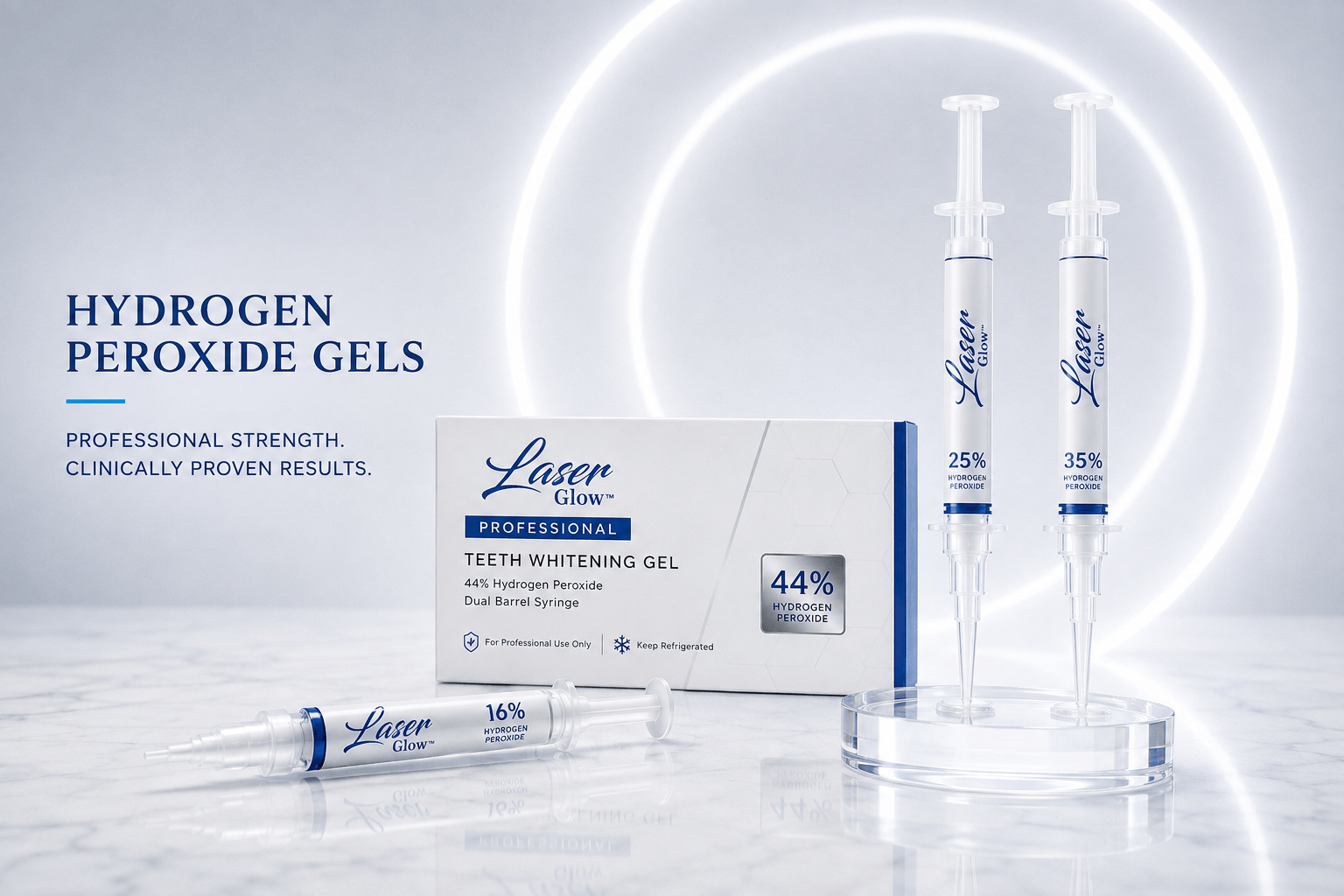
Concentration determines both the intensity of the chemical reaction and the sensitivity risk. 16% hydrogen peroxide is a lower-sensitivity option suited for lighter cases, first-timers, or patients with sensitivity-prone enamel. 25% hydrogen peroxide is a balanced professional strength appropriate for most whitening cases, widely used across salon, spa, and professional whitening settings. 35% hydrogen peroxide is dentist-grade — it requires a gingival barrier to protect the soft tissue and is not appropriate for self-application without trained provider supervision. LaserGlow's professional line also includes 36% and 44% dual-barrel HP systems for advanced professional use. The right concentration depends on your staining profile, sensitivity tolerance, and whether you're self-applying at home or working with a trained provider in a clinical setting.
Ready to Start
Book a Session or Shop the Kit
Know what to expect, manage the window around your session correctly, and LED whitening delivers — at home or in the chair.