Purple whitening strips are one of the most argued-about products in oral care. Half the internet says they transformed their smile in a week. The other half — including a lot of dentists — calls them an optical illusion in a sachet. Both camps are describing something real, and the reason they disagree is that they're talking about two completely different products that happen to share a color.
We sell professional whitening gels to dental offices, med spas and whitening providers, and we whiten people chairside in our own treatment rooms. That gives us an unusual position on this question: we make money either way, so we don't need purple strips to be magic. Here's what they actually do.
The short answer: Purple whitening strips work, but only if you understand which of two mechanisms you're buying. The violet pigment neutralizes yellow tones instantly through color theory, and that effect is real but temporary. Any lasting change comes from a whitening active underneath — usually PAP or peroxide. A strip with dye and nothing else brightens your appearance for a few hours. A strip with dye plus an active does that and works on the stains.
Key takeaways
- Violet cancels yellow on the color wheel — the instant brightening effect is genuine, not marketing
- That optical effect fades within hours as the pigment wears off your enamel
- Lasting results require an active ingredient: PAP or hydrogen peroxide
- Dye-only purple strips exist and are widely sold — the label tells you which you're buying
- Contact time is why a 30-minute strip outperforms a 2-minute purple toothpaste
- Nothing purple changes the color of veneers, crowns or bonding
Why the strip is purple in the first place
Violet sits directly opposite yellow on the color wheel. Lay one over the other and they neutralize, which the eye reads as a cooler, cleaner, brighter surface. This is not a new or fringe idea. It's the same principle behind purple shampoo for brassy blonde hair, green-tinted concealer for redness, and the blue dyes manufacturers add to white laundry detergent and paper to make them look whiter than they are.
Applied to teeth, the mechanism is straightforward. Surface staining from coffee, tea, red wine, dark sauces and tobacco reads as warm yellow. A violet layer sitting on the enamel offsets that warmth. You don't remove anything — you change how the light coming off the tooth is perceived.
Because it's optical rather than chemical, it's also immediate. There's no waiting period, no build-up, no oxidation happening slowly beneath the surface. You peel the strip off and the effect is already there. That instant payoff is exactly why purple products exploded on social media, and it's a legitimate reason to own them.
Worth knowing
The color-correction effect is strongest on teeth with genuine yellow undertones. If your discoloration reads gray, brown or bluish rather than yellow, violet has nothing to cancel and you'll see very little from the pigment layer.
What purple alone cannot do
Here's the part most brands leave out. Color correction is a finish, not a change. The pigment sits on the enamel surface and wears away over the following hours through saliva, drinking, eating and brushing. By the next morning, you're back to your starting shade.
This is the substance behind the dentist skepticism you've seen on social media, and the criticism is fair when it's aimed at dye-only products. Research on peroxide-free color correctors has consistently found that they produce a measurable but temporary shift in perceived tooth color after a single application, with reviewers explicitly noting the change is visual rather than a permanent lightening of the tooth. As of 2026, there are no peer-reviewed randomized controlled trials showing that a dye-only purple formula permanently whitens teeth — because that isn't what dye does.
So if you buy a purple strip expecting a permanent shade change and the product contains nothing but violet pigment, you will be disappointed on day 15. That's not the product failing. That's a mismatch between what it does and what you were told it does.
The useful question isn't "do purple strips work." It's "does this purple strip have anything in it besides the purple."
PAP: the ingredient that separates a whitening strip from a tint
PAP — phthalimidoperoxycaproic acid, which is why everyone abbreviates it — is a peroxide-free whitening active. It oxidizes the chromogen molecules responsible for staining, breaking their chemical bonds so they stop absorbing light in the visible range. In plain terms, it makes stain compounds colorless rather than covering them up.
The important structural difference from peroxide is that PAP does this without releasing free radicals. Hydrogen peroxide whitens by generating reactive oxygen species, and those same reactive species are implicated in the enamel softening, gum irritation and nerve sensitivity that make peroxide whitening uncomfortable for a large minority of people. PAP oxidizes the stain directly and skips that step.
In laboratory comparisons, PAP formulations have performed close to hydrogen peroxide on measured lightness change while showing considerably less impact on enamel surface microhardness. The evidence base is younger and thinner than the decades of research behind peroxide — that's an honest caveat, not a footnote — but the direction of the findings has been consistent across the studies published so far.
Better formulations pair PAP with supporting ingredients: hydroxyapatite, which is the mineral enamel is largely made of and which helps smooth the enamel surface, and potassium nitrate or potassium citrate, which reduce nerve sensitivity. Neither whitens on its own. Both make the course easier to finish.

Why finishing matters more than strength
Sensitivity is the single most common reason people abandon a whitening course partway through. A gentler formula you complete beats a stronger one you quit on day four. That's the entire argument for PAP, and it's why our purple strips are built on PAP rather than peroxide.
PAP vs. hydrogen peroxide: which one should you actually use
Neither is universally better. They solve different problems, and the right answer depends on your teeth rather than on which ingredient has better marketing.
| Factor | PAP | Hydrogen peroxide |
|---|---|---|
| Mechanism | Oxidizes stain compounds directly, no free radicals released | Releases reactive oxygen species that break stain molecules apart |
| Typical sensitivity | Low — the usual choice for people who couldn't finish a peroxide course | Transient sensitivity is common and well documented |
| Speed | Gradual across the course | Faster visible chemical lightening |
| Evidence base | Promising but younger, more in vitro than clinical | Decades of clinical research, ADA-recognized |
| Best for | Surface staining, sensitive teeth, ongoing maintenance | Deeper staining, people without sensitivity, maximum lift |
If you've never had a problem with peroxide strips and you want the biggest possible change, peroxide is still the heavier tool — and a professional in-office treatment using a high-concentration gel under a gingival barrier is heavier still. If peroxide has made your teeth zing, or you're maintaining rather than transforming, PAP is the better fit.
Purple strips vs. purple toothpaste: contact time decides it
Purple toothpastes and color-correcting serums use the same violet pigment logic, and they're genuinely useful as a daily brightening step. But they have a structural limitation that no formula can engineer around: you rinse them out after about two minutes.
That matters for both mechanisms. The pigment gets barely any time to deposit evenly, and any whitening active in the formula gets nowhere near the contact time it needs to oxidize anything. Reviews of over-the-counter whitening have repeatedly found strips to be the most effective at-home format, outperforming toothpastes, rinses and paint-on gels — and the reason given is consistently the combination of higher active concentration and far longer contact with the enamel.
A strip stays on for 30 minutes. That's roughly fifteen times the contact of a brushing session, held in place against the tooth surface instead of being diluted by saliva and spat out.
The practical answer is that they aren't competitors. Purple toothpaste is the daily maintenance step. Strips are the treatment. Run the strip course, then hold the result with the toothpaste.
Are purple whitening strips safe for enamel?
For a well-formulated peroxide-free strip, the evidence is reassuring, with three things worth checking.
The active. PAP has not shown the reduction in enamel surface microhardness that high-concentration peroxide gels produce in laboratory testing. Peroxide isn't dangerous when used correctly either — it's the most studied whitening agent there is — but it demands more respect around wear time.
The pH. This gets almost no attention and matters more than the active. An acidic formula can demineralize enamel regardless of what's whitening. Formulations buffered toward neutral avoid doing acid work on your teeth while they sit there for half an hour.
The dye itself. The violet pigments used in these products are standard cosmetic-grade colorants also found in toothpastes and mouthwashes. They sit on the surface and rinse away.
The genuine risks with any whitening strip are behavioral rather than chemical: leaving them on longer than directed, doubling up treatments, running back-to-back courses, or whitening over untreated decay, active gum disease or exposed root surfaces. Longer does not mean whiter. It means irritated.
See a dentist first if
You have untreated cavities, gum disease, exposed roots, dental pain, or discoloration that's gray, brown, internal, trauma-related or medication-related. Whitening won't fix any of those, and it can make some of them worse.
What results actually look like across 14 days
Setting the expectation correctly is most of the battle. Here's an honest picture of a two-week course on ordinary surface staining.
Noticeably brighter the moment the strip comes off. That's the pigment. It fades over the next several hours.
The instant effect still happens daily, and a subtle baseline shift begins as PAP works on surface stains.
A modest, real improvement in your resting shade, plus the instant lift whenever you use one.
Two mechanisms, two timelines. Day one flatters you. Day fourteen changes your starting point — modestly. Anyone promising a dramatic multi-shade transformation from a peroxide-free strip is overselling, and you should treat before-and-after imagery that looks like a veneer case with appropriate suspicion.
Results also depend heavily on what caused your staining. Extrinsic staining from food, drink and tobacco responds well. Intrinsic discoloration — the natural yellowing of dentin with age, tetracycline staining, fluorosis, trauma — largely doesn't, for any at-home product.
This is also why course length matters more than most people assume. Our peroxide-free purple strips ship as 14 sealed pairs precisely because that's the window where PAP does its work — not so short that nothing accumulates, not so long that you're irritating your gums chasing diminishing returns.
Who purple whitening strips genuinely don't work for
We'd rather lose a sale than take a return, so here's the honest exclusion list.
- Anyone with veneers, crowns, bridges or composite bonding on their front teeth. These contain no natural enamel. They won't lighten, and if your natural teeth do, the mismatch becomes more visible than before you started.
- Deep intrinsic or tetracycline staining. This needs professional assessment, and sometimes restorative work rather than whitening.
- Anyone wanting a one-session transformation. That's in-office whitening, not a strip.
- Gray or brown discoloration. Violet cancels yellow specifically, and PAP targets surface staining.
- Under-12s, and anyone pregnant or nursing without checking first.
How to tell a real purple strip from a tinted one
This is the most useful thing in this article, so use it before your next purchase. Turn the box over — or open the ingredient list on the listing — and look for the following.
- A named whitening active. PAP, phthalimidoperoxycaproic acid, hydrogen peroxide or carbamide peroxide should appear. If the only functional ingredients are colorants, you're buying a tint.
- Colorants listed as colorants. CI 42090 and CI 17200 are the violet dyes. Their presence is fine and expected — their presence alone is the problem.
- Supporting ingredients. Hydroxyapatite, potassium nitrate or potassium citrate signal a formulator thinking about enamel and comfort, not just color.
- A stated wear time of 15 minutes or more. Very short wear times suggest the product is relying on the pigment.
- Honest language on the page. Brands that explain the temporary nature of color correction are telling you they have something else in the formula. Brands that only shout about instant results usually don't.
That last one is the fastest tell. A company selling a genuine active has no reason to hide behind the pigment.
Run that checklist against anything you're considering, including ours. The full ingredient breakdown for LaserGlow Purple Teeth Whitening Strips is published on the product page: PAP named as the active, violet colorants declared, pH buffered toward neutral, 30-minute wear time.
How to get the most out of your 14 days
Most disappointing strip experiences come down to application rather than formula. Five things make a measurable difference.

Start dry. Brush, then let your teeth surface-dry before applying. Dry hands too. Skip the steamy bathroom straight after a shower — humidity stops the strip seating properly and it will slide.
Place below the gum line, not over it. Line the strip edge just below where tooth meets gum. Overlapping onto soft tissue is what causes most irritation reports.
Press, then fold. Press the strip onto the tooth face with a dry fingertip so there are no air gaps, then fold the remainder behind your teeth. Air gaps produce patchy results.
Respect the clock. Thirty minutes, once a day. Not sixty. Not twice. Extended contact adds irritation, not brightness.
Finish the course, then protect it. Complete all 14 treatments before judging results. Afterwards, your teeth are briefly more receptive to staining — go easy on coffee, tea, red wine and dark sauces for the first day or two.

Purple that has something behind it
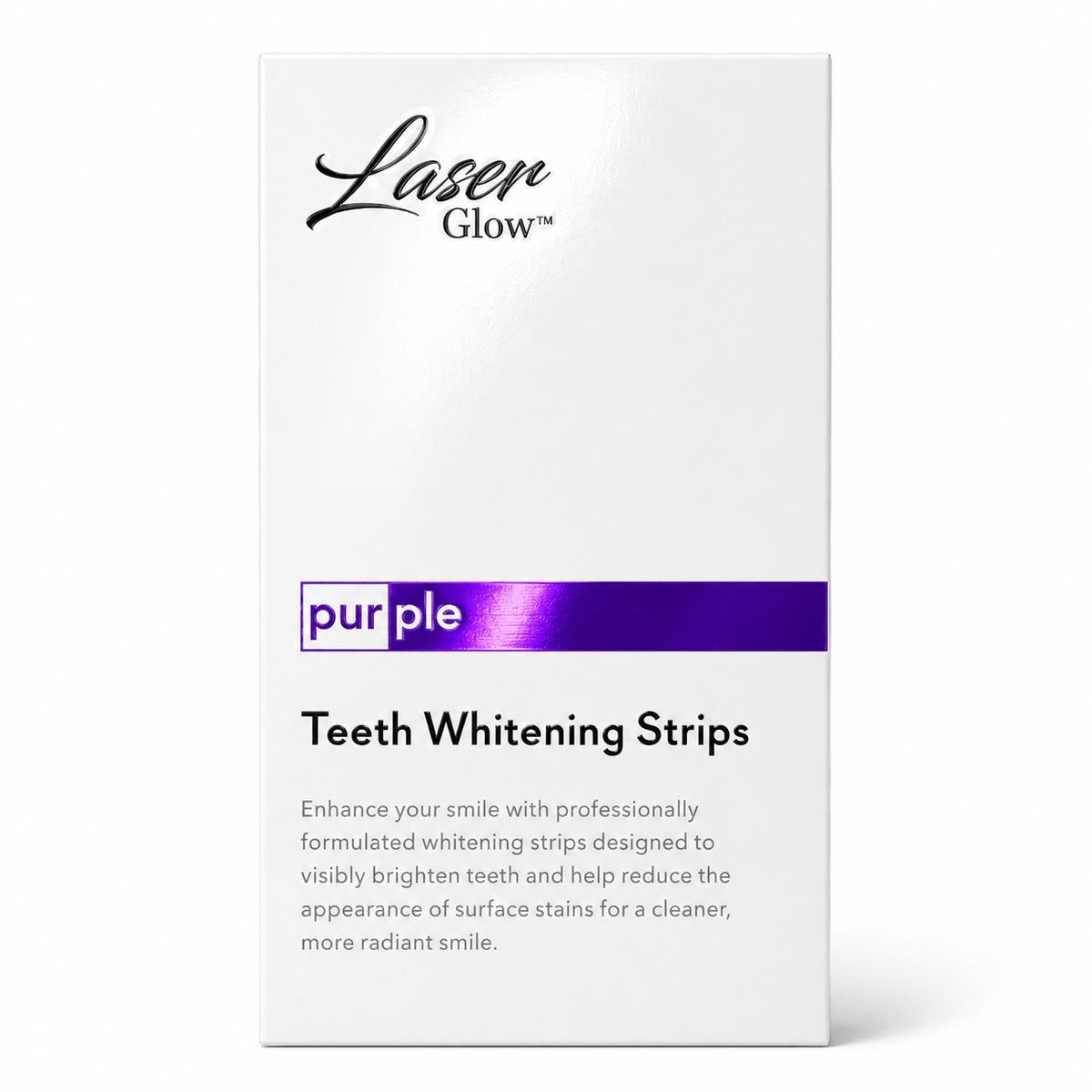
LaserGlow Purple Teeth Whitening Strips pair violet color correction with PAP, so you get the instant brightening and an active working on the stains underneath. Peroxide-free, 14 sealed pairs, 30 minutes a day. See the strips — or if you want a bigger change in a single visit, book an in-office treatment in New Jersey.
Frequently asked questions
Do purple teeth whitening strips actually work?
Yes, with an important distinction. The violet pigment neutralizes yellow tones instantly through color theory, which is real but temporary and fades within hours. Any lasting change comes from a whitening active such as PAP or peroxide underneath the dye. A strip containing only pigment brightens your appearance for an evening. A strip with pigment plus an active does that and works on the stains as well.
How long do purple whitening strip results last?
There are two answers because there are two effects. The color-correction layer is immediate and wears off over several hours through saliva, eating and brushing. Results from a whitening active build across the full course and hold considerably longer, though they fade gradually as new staining accumulates from coffee, tea, wine and tobacco. Most people maintain with occasional single treatments rather than repeating full courses.
Are purple whitening strips safe for tooth enamel?
A well-formulated peroxide-free strip has a reassuring safety profile. PAP has not shown the reduction in enamel surface microhardness that high-concentration peroxide gels produce in laboratory testing, and the violet colorants are standard cosmetic-grade pigments also used in toothpaste. Check that the formula is pH-buffered toward neutral, follow the stated wear time exactly, and don't run treatments back to back.
What is PAP in teeth whitening?
PAP stands for phthalimidoperoxycaproic acid, a peroxide-free whitening active. It oxidizes the stain compounds that make teeth look discolored, breaking their chemical bonds so they no longer absorb visible light. Unlike hydrogen peroxide it does this without releasing free radicals, which is why it's generally associated with lower sensitivity. It's frequently paired with hydroxyapatite and potassium salts for enamel support and comfort.
Are purple whitening strips better than purple toothpaste?
They do different jobs. Toothpaste rinses out after about two minutes, so the pigment has minimal contact time and any active has almost none. A strip stays against the tooth for around 30 minutes. Reviews of over-the-counter whitening consistently find strips to be the most effective at-home format, largely because of contact time. Use the strips as the treatment and the toothpaste as daily maintenance afterwards.
Can I use purple whitening strips with veneers or crowns?
They won't damage restorations, but they won't change their shade either. Veneers, crowns, bridges and composite bonding contain no natural enamel and don't respond to whitening chemistry or color correction in the same way. If your natural teeth lighten while restorations stay the same, the mismatch can become more noticeable. If your front teeth are restored, speak with your dentist before starting.
Will purple whitening strips make my teeth sensitive?
Peroxide-free formulas are specifically chosen by people who couldn't tolerate conventional strips, and PAP is associated with lower sensitivity because it doesn't generate free radicals. Temporary sensitivity or tingling can still occur with any whitening product, particularly if you already have exposed root surfaces, enamel wear or gum recession. Discontinue use if irritation occurs and speak with your dentist.
How often should you use purple whitening strips?
Once a day for 30 minutes across a 14-day course, then stop. Don't extend the wear time or run two treatments in a day — longer contact adds irritation without adding brightness. After the course, most people top up with a single treatment before events rather than starting another full course immediately.
Why do some dentists say purple whitening products don't work?
Because the criticism is usually aimed at dye-only formulas, and for those it's accurate. A product containing violet pigment and nothing else creates a temporary optical effect and removes no staining at all. That criticism doesn't transfer to strips that combine color correction with an actual whitening active. The distinction is on the ingredient list, not in the color.
This article is general educational information, not dental advice, and it isn't a substitute for assessment by a licensed dental professional. Individual results vary with the type and severity of staining. If you have dental work, ongoing sensitivity, or discoloration that isn't clearly surface staining, speak with your dentist before whitening.