Teeth whitening career guide
How to become a teeth whitening technician: confirm what your state allows, complete structured training, practice the full workflow on a model, then prepare your forms, insurance and one clear service. This guide covers the role, where technicians work, what a certificate really means and what training costs.
Short answer: check the rules where you work, complete a structured course with an assessment, rehearse the full appointment on a model, then set up forms, insurance and a single service. A course certificate is not a license.
The practical path
How to become a teeth whitening technician in six steps
A teeth whitening technician delivers a cosmetic whitening service through a defined workflow: consultation, screening, shade documentation, retractor placement, moisture control, gum protection, gel application, light positioning, monitoring, gel removal and aftercare. The best technicians are not the fastest. They repeat the same organized process for every appropriate client.
- Check the rules where you workState, local health, business, facility and insurance requirements for your provider type. Confirm the rules in your state first.
- Complete structured trainingConsultation, whitening fundamentals, products, workspace setup, isolation, application, aftercare and troubleshooting.
- Watch the full procedureVideo demonstrations connect written steps to hand position, product control and appointment flow.
- Practice before clientsRehearse setup, retractor placement, barrier application and controlled gel placement on a typodont or practice model.
- Prepare the client experienceConsultation, consent, treatment records, photography and aftercare, ready before the first booking.
- Launch one clear serviceOne repeatable appointment, not a menu of strengths, packages and upgrades.
Where whitening technicians work
What a teeth whitening technician does day to day
Whitening technicians work in very different settings. What changes is the client mix, the gel strengths a setting typically uses and how much of the business side you own.
Salons & estheticians
Whitening as a beauty-menu add-on, where state rules allow. Often starts at 16% to 25% HP.
16% HP protocol →Med spas
A premium add-on with documented protocol, client screening and tiered pricing.
Teeth whitening for med spas →Studios & mobile
Dedicated whitening businesses that live on volume, consistent yield and rebooking.
Teeth whitening business hub →Tooth gem artists
Adding whitening to a gem menu, with timing rules for whitening and placement on the same client.
Teeth whitening with tooth gems →Across every setting the core skills are the same: screening clients and knowing when to postpone or refer, protecting soft tissue, controlling the product, documenting shade, and explaining that crowns, veneers and bonding do not whiten. Professional gels are for trained providers only and never for home or tray use.
Understand the terminology
Training, certificate, license: not the same thing
Search results use “teeth whitening course,” “training,” “certification” and “certificate” as if they meant the same thing. They do not.
-
01
Training
The educational program: lessons, videos, manuals, practice guidance, forms and assessments.
-
02
Certificate of completion
A document from a private provider confirming you finished its program and passed any required assessment.
-
03
Professional license
Government or regulatory authorization tied to a defined scope of practice. A private course cannot issue one.
-
04
Accreditation
Formal recognition by a named accrediting body. Never assume it unless the provider names the accreditor and you can verify it.
Course completion is not a license. A certificate shows you invested in structured education, but it does not authorize services everywhere or turn a non-dental provider into a dental professional. Depending on where you work, check with your state dental board, cosmetology or personal-services regulator, health department, local licensing office and insurer. Rules outside the US differ too; in the United Kingdom, tooth whitening is restricted to registered dental professionals.
Planning your investment
Teeth whitening technician training: time, cost and equipment
How long it takes
Self-paced online programs may take several hours, one focused day or a number of study sessions, depending on lessons, demonstrations and assessments.
Finishing the videos is not the same as being ready. Build model practice and full-workflow rehearsal into the timeline.
What it costs
Training-only programs often cost a few hundred dollars; programs bundled with an LED whitening machine, curing light, gels, barrier and disposables can run well over $1,000.
Judge the education separately from the equipment. A large kit does not make up for shallow training. To compare programs, use the checklist for choosing a teeth whitening course.
The American Dental Association notes that hydrogen peroxide and carbamide peroxide are the common whitening agents, that only natural teeth whiten, and that temporary sensitivity and gum irritation are common side effects. That is why training has to cover screening, expectations, product control and aftercare, not just application.
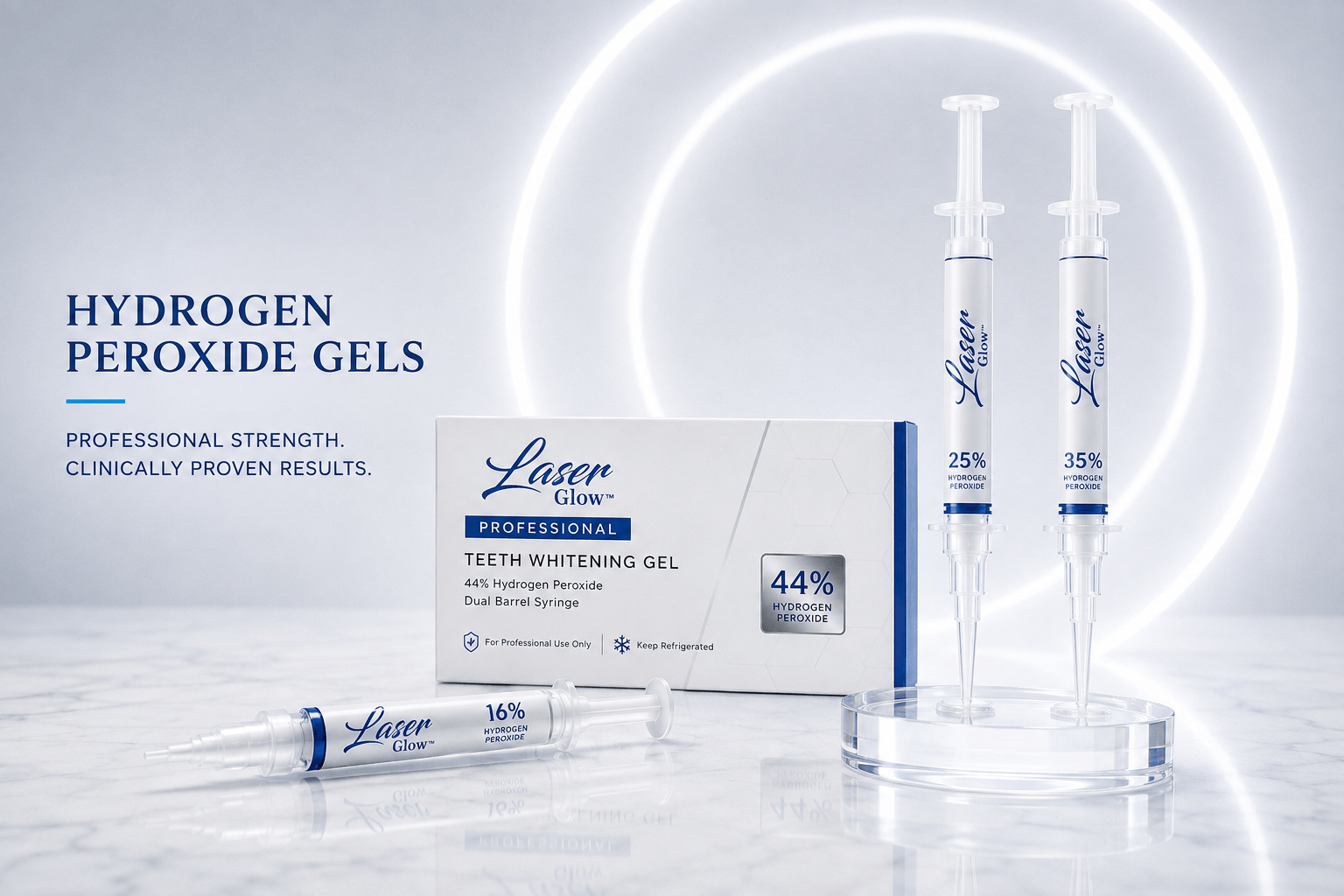
You don’t need equipment before you start a course, but you do before you practice the full workflow. A typical setup includes an LED whitening light, a curing light, retractors, a shade guide, eyewear, gingival barrier, whitening gel and aftercare. The barrier is required with every LaserGlow professional hydrogen peroxide gel and mandatory at 35% and above. Itemized lists live in the teeth whitening equipment list; matching gel strength to the client is covered in which whitening gel strength to use.
From certificate to first client
Teeth whitening technician salary and your first clients
What a technician earns
There is no reliable published salary figure, and any course that promises income should be treated as a red flag. Earnings depend on whether you are employed or independent, your market, your booking volume and your costs.
Independent providers commonly price a session between $99 and $300, with many around $150 to $200. What you keep depends on labor, rent and fees, so work it out with the teeth whitening cost per client formula.
Before your first paying client
Turn the certificate into a workflow
- Review the full appointment, consultation to aftercare
- Rehearse retractor, barrier and gel placement on a model
- Finalize screening, consent, photo and aftercare forms
- Confirm licensing, facility and insurance requirements
- Set up consistent before-and-after photography
Launching your own service? Models, startup budget, pricing, marketing and a 30-day plan are in the teeth whitening business hub, and the free teeth whitening forms PDF covers intake and consent.
FAQ
Teeth whitening technician FAQ
Quick answers about the career path. Comparing programs? Use the teeth whitening course checklist.
How do I become a certified teeth whitening technician?
Complete a structured training program and its required assessment to receive that provider’s certificate of completion.
Then practice the workflow, prepare your client systems and confirm the rules in your state and your insurance before offering services.
Do I need a license to be a teeth whitening technician?
It depends on your state, provider type, product and service model. Some states restrict whitening to dental professionals or require supervision.
A private training certificate does not replace government or professional authorization. Check with your state dental board.
Do I need dental or beauty experience first?
Not necessarily. Beginner programs start with whitening fundamentals and build to the full appointment.
Dental and experienced beauty professionals may move faster through the basics but still need the product-specific workflow.
Can teeth whitening technician training be completed online?
Yes. Many programs offer self-paced lessons, video demonstrations, manuals, assessments and digital certificates.
You still need to practice the hands-on steps on a model before working with a paying client.
Is a teeth whitening certificate the same as a dental license?
No. It documents completion of a private training program. It is not a dental degree, a professional license or authorization to practice everywhere.
Who takes teeth whitening technician training?
Estheticians, salon professionals, med spa teams, tooth gem artists, studio owners, entrepreneurs and dental professionals.
What each person may legally offer depends on location and professional scope.
What certificate does LaserGlow provide?
Students who complete the required lessons and pass the final assessment receive a personalized LaserGlow Teeth Whitening Training Certificate of Completion.
It confirms completion of LaserGlow’s private training program. See teeth whitening certification for the curriculum.
Learn the complete workflow at your own pace
Eight modules, 34 lessons, five practical demonstrations, a 70+ page manual, client forms and a final assessment. Course completion is not a license; confirm the rules in your state.