Tooth shade guide basics
A teeth color chart is the set of reference shades dentists and whitening providers use to name tooth color, and the most common one runs from B1, the lightest, to C4, the darkest. Here is what each letter and number means, what natural teeth color looks like, whether B1 is too white and what whitening can realistically change.
Short answer: On the VITA classical teeth color chart, B1 is the lightest natural shade and C4 the darkest. Most natural teeth fall in the A range, and a light ivory or yellow tone is normal.
Reading the chart
The teeth color chart, explained: letters and numbers
A teeth color chart, also called a tooth shade chart (or a teeth colour scale in UK spelling), is a set of reference tabs used to name the color of a tooth. The most widely used one is the VITA classical shade guide: 16 tabs arranged in four letter groups. The letter is the hue family; the number is how light or dark the tab is within that family.
-
A
Group A: reddish-brown
Tabs A1, A2, A3, A3.5 and A4. The warm family where most natural teeth fall, so A shades come up often at dental visits.
-
B
Group B: reddish-yellow
Tabs B1, B2, B3 and B4. A cleaner, more yellow family. B1 is the lightest tab on the whole classical guide.
-
C
Group C: greyish
Tabs C1, C2, C3 and C4. Cooler grey tones. C4 sits at the very bottom of the commonly used lightness order.
-
D
Group D: reddish-grey
Tabs D2, D3 and D4. A grey family with a warm cast. There is no D1 tab on the classical guide.
What the number means
Inside each letter group, the number tells you lightness: 1 is the lightest and 4 the darkest. So A1 is lighter than A2, and A2 is lighter than A3.
The number only ranks shades inside one group, which is why a separate lightness order exists across the whole chart.
A1 tooth shade
What does A1 mean?
A1 is the lightest tab in the reddish-brown A group. On the lightness order below it sits second, just after B1. Many people consider A1 a bright but still natural-looking result.
Whitest to darkest
Teeth shades in order, from lightest to darkest
Because the letter groups overlap in lightness, shade matching often uses a single value ranking across all 16 tabs. The table shows a commonly used lightness order for the VITA classical guide.
| Rank (1 = lightest) | Shade tab | Group | Hue family |
|---|---|---|---|
| 1 | B1 | B | Reddish-yellow |
| 2 | A1 | A | Reddish-brown |
| 3 | B2 | B | Reddish-yellow |
| 4 | D2 | D | Reddish-grey |
| 5 | A2 | A | Reddish-brown |
| 6 | C1 | C | Greyish |
| 7 | C2 | C | Greyish |
| 8 | D4 | D | Reddish-grey |
| 9 | A3 | A | Reddish-brown |
| 10 | D3 | D | Reddish-grey |
| 11 | B3 | B | Reddish-yellow |
| 12 | A3.5 | A | Reddish-brown |
| 13 | B4 | B | Reddish-yellow |
| 14 | C3 | C | Greyish |
| 15 | A4 | A | Reddish-brown |
| 16 | C4 | C | Greyish |
What is the whitest tooth shade?
On the classical teeth color chart, B1 is the whitest natural shade. Some shade systems go further with bleached shades lighter than B1: VITA’s 3D-Master guide adds 0M1 to 0M3, and other systems label them BL. These describe whitened teeth rather than anything typical in nature.
A1 vs B1 vs A2: which is whiter?
B1 is the lightest, A1 comes next, and A2 is several steps darker in the commonly used order. B1 reads slightly cleaner and more yellow-white; A1 has a touch more warmth. A2 is a very common everyday shade.
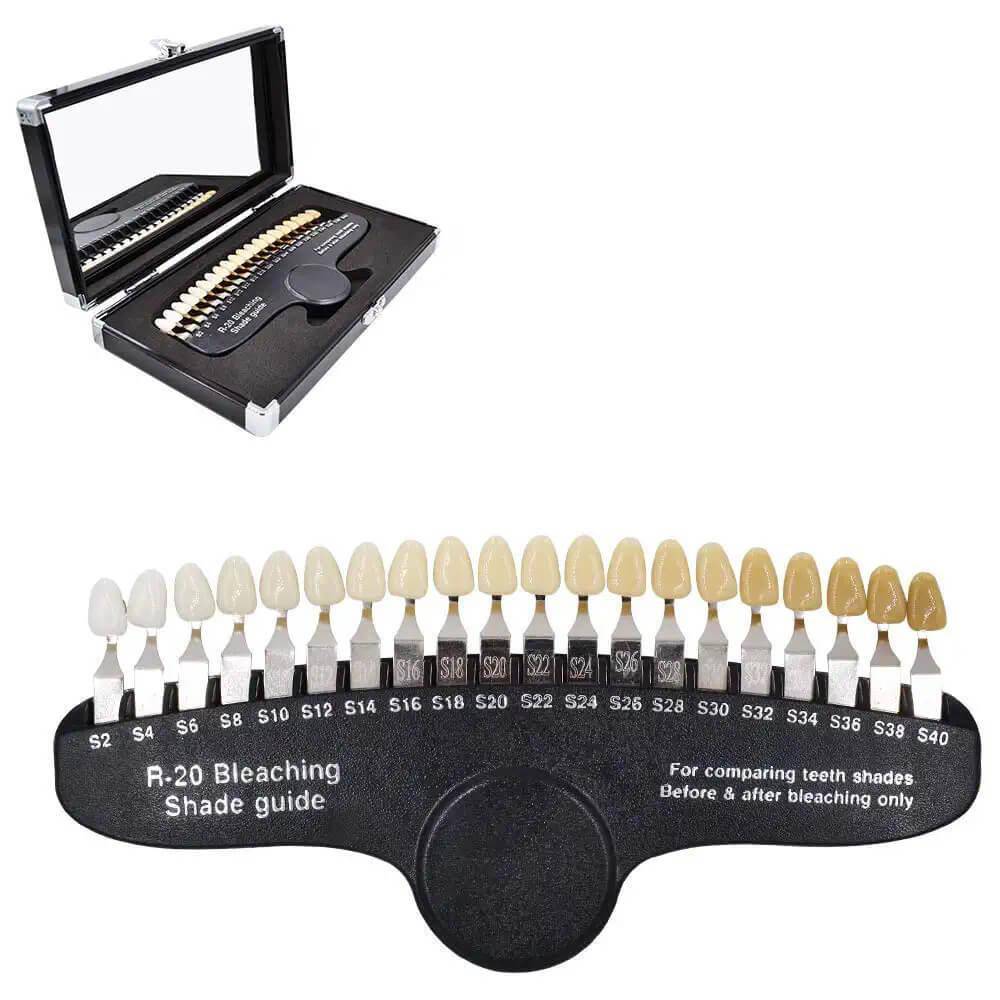
Screens and phone cameras shift color, so no on-screen chart can tell you your exact shade. A physical reference is the only reliable comparison: see the LaserGlow teeth shade guide, a 20-shade tab set built for whitening consultations.
Normal tooth color
What is the natural color of teeth?
The most searched question about any tooth shade chart is simply what normal looks like.
Natural teeth color is not pure white
Healthy natural teeth are an off-white, ivory or light yellow tone, not the bright white of paper. Most natural teeth sit somewhere in the A range of the chart.
The outer enamel layer is slightly translucent, and the dentin underneath is naturally more yellow. What you see is a blend of the two.
Is yellow the natural color of teeth?
A light yellow or ivory tone is normal. Teeth also tend to darken and turn more yellow with age: enamel wears thinner over the years, so more of the yellower dentin shows through.
Strong yellow, brown or grey color, or one tooth that looks different from its neighbors, is worth showing to your dentist before you think about whitening.
What color should healthy teeth be? Healthy teeth can sit anywhere across the lighter half of the chart. A shade such as A2 or A3 is not a sign of poor health, and B1 is not the standard everyone should reach.
B1 tooth shade
Is B1 tooth shade too white?
There is no single answer, because how white a shade looks depends on what surrounds it: skin tone, gum color, lip color and your other teeth.
Where results start to look artificial
The shades that most often look fake are the bleached shades brighter than B1, especially when they flatten the natural translucency at the edges of the teeth. Opaque, uniform white tends to read as artificial on camera and in person.
A practical way to decide
Hold your current tab and the one you are aiming for against your teeth in a mirror, in daylight, with your usual lip color. If the lighter tab looks like a different person’s smile, A1 may be the better goal. Whether you can reach either depends on your teeth.
Find your shade
What shade are my teeth? How to check it
- Use good lightDaylight or a daylight-balanced lamp. Warm indoor bulbs make teeth look more yellow than they are.
- Keep teeth moistDry teeth look lighter and chalkier. Swallow or wet them first, and check quickly.
- Pick the right areaCompare against the middle third of an upper front tooth, not the thinner edge or the area by the gum.
- Hold tabs side by sidePut the tab next to the tooth at the same level and pick the closest match.
- Photograph with the tab in frameA photo with the matching tab beside the tooth makes later comparisons fair.
- Record before and afterWrite down the starting tab and re-check the same way after whitening, ideally a couple of days later.
Why your shade can look lighter right after whitening: teeth are slightly dehydrated after a session, so they can look brighter than they will settle. The shade typically settles over 24–48 hours, which is why a re-check after that window gives the truer result.
For a full walkthrough of how providers document results in a session, read teeth whitening before and after. Professionals tracking clients can use the 20-shade teeth whitening guide.
Whitening and shade
What whitening can change on the teeth color chart
A shade chart shows what whitening did, and it also sets honest limits on what it can do.
Natural enamel lightens
Peroxide whitening lightens natural tooth structure. How far your shade moves depends on your starting shade, stain type and enamel, so no number of shades can be promised.
Is teeth whitening safe? →Restorations stay the same
Veneers, crowns and bonding do not change color with whitening. Whitened natural teeth can end up lighter than an existing restoration.
Can you whiten veneers? →Comfort matters
Some people feel temporary sensitivity during or after whitening. A lower-strength plan and aftercare can help.
Teeth whitening for sensitive teeth →Shade drifts back slowly
Professional results commonly hold 6–18 months, depending on diet, tobacco and oral hygiene.
How long does teeth whitening last? →Protect a new shade in the first days with the teeth whitening aftercare guide and a list of what to eat after teeth whitening. Longer term, see teeth whitening maintenance. Weighing your options first? Compare professional vs at home teeth whitening.
Optical tricks
What colors make your teeth look whiter?
- Blue-based lip colors, such as berry and blue-red shades, tend to make teeth look brighter than orange- or brown-based ones
- Contrast helps: a deeper lip color or a darker top near the face makes teeth read lighter by comparison
- Purple color-correcting toothpaste offsets yellow tones temporarily. The effect is cosmetic and optical, not a change in shade
- Cool, daylight-style lighting flatters teeth in photos; warm bulbs and warm filters push them toward yellow
LaserGlow Purple Toothpaste is a quick color correction for natural teeth. It will not change veneers, crowns or bonding, so it is not the right product if your visible front teeth are restorations. Use as directed.
What does A1 mean on a teeth color chart?
A is the reddish-brown hue group and 1 is its lightest tab. A1 is the second-lightest shade in the commonly used lightness order, after B1.
Is A2 a good tooth shade?
Yes. A2 is a common natural shade and is not a sign of unhealthy teeth.
What is the most common natural tooth shade?
Most natural teeth sit in the A range of the VITA classical guide.
Can whitening get my teeth to B1?
Sometimes, but no provider can promise a target shade or a number of shades.
Your starting shade, stain type and enamel decide how far natural teeth lighten. Restorations do not change.
Can I find my tooth shade from a photo or an online chart?
Not accurately. Screens, cameras and room lighting all shift color.
Compare a physical shade tab to your tooth in daylight, or ask your provider to record your shade at a visit.
Do crowns and veneers have a shade too?
Yes. Restorations are made to match a shade tab, but they do not lighten with whitening.
If you plan to whiten and replace a restoration, whiten first so the new one can be matched. See can you whiten veneers.
Want your shade checked in person?
LaserGlow records your starting shade at in-office whitening sessions, so you can see the change against a fixed reference.