Tooth gem removal
How to remove tooth gems safely: have a trained provider release the bond with a controlled removal instrument and polish the composite away, instead of prying the gem off at home. Here is what professional tooth gem removal involves, why DIY attempts risk your enamel, and what to do if a gem comes loose.
Short answer: book a professional removal. The bond is released with sideways pressure, the residue is polished off, and the enamel is left smooth in about five to ten minutes.

Start here
Why the way you remove a tooth gem matters
Every tooth gem comes off eventually. Knowing how to remove tooth gems correctly matters as much as how they went on.
Enamel doesn’t grow back
A correctly applied gem sits on the enamel surface. It isn’t embedded in the tooth, so a correct removal leaves the tooth intact.
Removal done wrong, by prying, picking or pulling, can scratch or fracture enamel and leave the tooth sensitive or permanently marked. Enamel does not regenerate once it is damaged.
The key principle
Release the bond, don’t force the crystal
The goal is to break the adhesive bond cleanly with controlled sideways pressure, then polish the surface. Popping or levering the gem off puts the force into the enamel instead.
Done with the right instrument, professional tooth gem removal is non-invasive and takes a few minutes.
DIY risks
How to remove tooth gems at home: why prying is the wrong move
The honest answer to “how do I take off a tooth gem myself?” is that you shouldn’t. Here is what people try and what it can cost them.
What people try, and the risk
- Fingernails: can chip enamel at the edge of the bond
- Toothpicks or hard objects as levers: can scratch or fracture enamel
- Acetone or solvents: not safe in the mouth, and they don’t reliably dissolve dental composite
- Biting hard foods to pop it: unpredictable force on the gem site and the enamel around it
What can go wrong
- Enamel micro-fractures that you can’t see but a clinician can detect
- The adhesive tearing away with a fragment of enamel
- A rough or pitted patch where the gem sat
- Sensitivity after aggressive attempts on the front of the tooth
| Method | Recommended? | Risk | Why |
|---|---|---|---|
| Professional removal | Yes | Minimal | Controlled sideways release, residue polished, surface finished |
| Fingernail or prying | No | Moderate to high | Unpredictable force; can chip enamel at the bond edge |
| Toothpick or hard object | No | High | Likely to scratch or damage the surface around the bond |
| Acetone or solvents | No | High | Not safe for oral tissue; won’t reliably dissolve dental adhesive |
| Leaving a loose gem on | No | Moderate | Bacteria collect under the lifted edge; book removal promptly |
In the chair
Tooth gem removal: how a professional does it
If you’re wondering how to remove a tooth gem without harming the tooth, this is the answer. Professional removal follows a controlled sequence that releases the bond without putting destructive force on the enamel.
- Inspect the gem and bondIs it fully bonded, partly lifted or loose? Note where the adhesive sits so it can all be polished away later.
- Isolate and dryA dry, clear view of the bond margin. Soft-tissue retractors protect the lip and cheek.
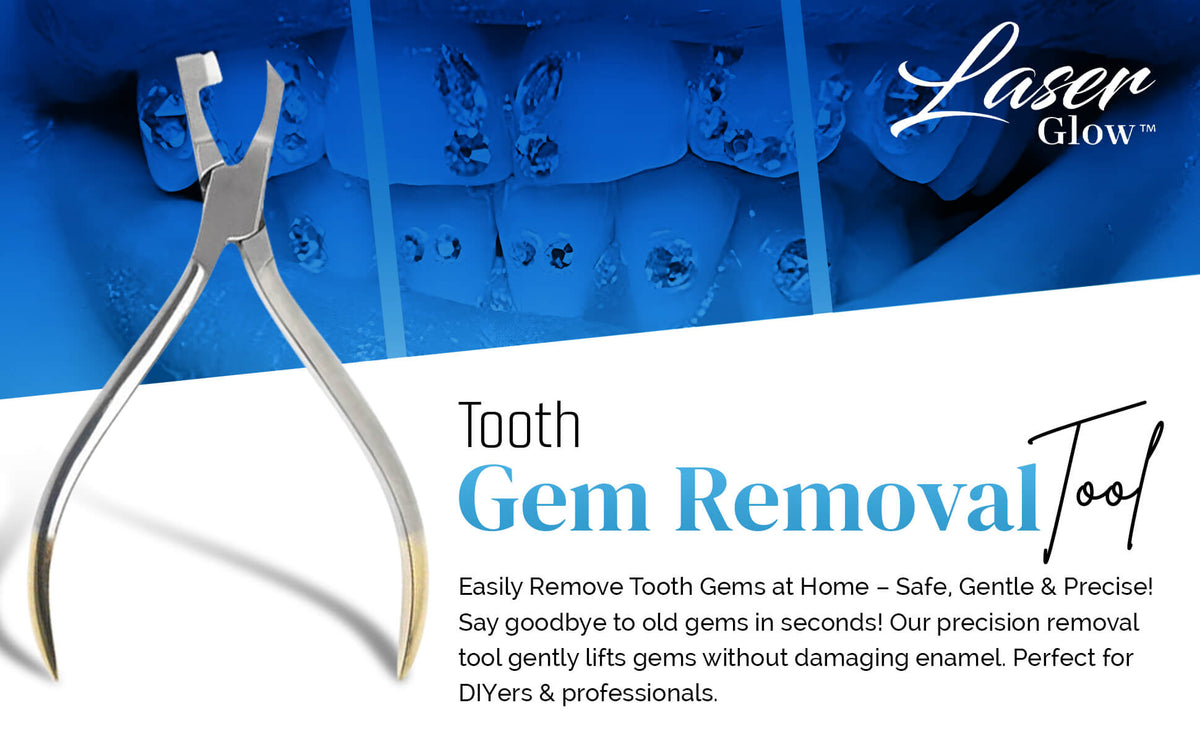
- Release with controlled pressureThe removal tool applies sideways pressure at the base of the gem to shear the bond. Sideways, not upward; never levered.
- Clear the residueA thin layer of composite almost always remains. Left in place it collects plaque and stain, so it is removed with fine polishing instruments.
- Polish the surfaceA fine-grit cup or point and fine prophy paste leave the enamel smooth, with no rough edges.
- Check and adviseA final look in good light. You’re told to call if you notice sensitivity or an unusual texture in the following days.
The whole visit usually takes five to ten minutes per gem, with no drilling and no anesthetic. If your gem already fell off and only composite is left, read how to get tooth gem glue off teeth instead.
For clients
How to get tooth gems off when one is loose or falls out
If your gem feels loose
- Book a removal or rebond promptly. A lifted gem traps bacteria under the edge
- Don’t press it back down or wiggle it free
- Never re-glue it with super glue or nail glue
If it already fell off
- Save the gem
- Leave the leftover composite alone; a professional can polish it cleanly
- Keep brushing gently over the spot until your appointment
Cost, timing and a new gem
Professional tooth gem removal typically costs $25 to $75, depending on the provider, the number of gems and how much polishing is needed. Some providers include removal in the original service fee; most price it separately.
Want a new gem? Once the residue is gone and the enamel is smooth, a new gem can usually go on the same day or at your next visit, on the same tooth or a different one. See tooth gem designs for ideas, or how much tooth gems cost.
Had your gem placed at LaserGlow? Contact the studio directly to schedule removal: Clifton, Edgewater or Paterson.
Searching for how to take off tooth gems because yours is bothering you? Book the appointment rather than waiting. Want to keep your next gem longer? Follow our tooth gem aftercare routine.
For tooth gem artists
Removal tools and when to refer to a dentist
The removal workflow
- Tooth gem removal tool for controlled sideways release at the bond base
- Scaler or bonding instrument for residue at the margin
- Soft-tissue retractor to keep the field clear
- Fine polishing cup or point and fine prophy paste
- Good lighting to inspect residue and enamel before and after
Tell every client at application that removal must be done professionally, and put it in your written aftercare.
Refer to a dentist if
- There is new pain or sensitivity at the gem site
- The enamel around the bond is discolored or stained
- The surface is rough, pitted or chalky after a failed DIY attempt
- Gum tissue around the gem is swollen or irritated
- Intake notes show enamel wear, cracks or hypersensitivity
- The gem was attached with an unknown adhesive, or adhesive has reached the gum margin
- A dental appliance nearby complicates access
When in doubt, refer rather than risk making things worse. LaserGlow protocols are written for adult clients.
Professional use only; follow product instructions and confirm the rules in your state. Training covers removal boundaries and referrals: see the tooth gem certification course.
FAQ
Tooth gem removal FAQ
Quick answers about taking tooth gems off. Still unsure? Contact our team.
Can I remove my tooth gem at home?
It isn’t recommended. Prying, picking or forcing a gem off can chip or micro-fracture the enamel at the bond site.
A trained provider can remove the gem and polish away the residue in a few minutes. If it falls off by itself, save it and book a polish rather than scraping at the leftover composite.
Does tooth gem removal hurt?
Usually not. There is no drilling and no anesthetic, and most clients feel only brief pressure as the bond releases.
Sharp pain is not normal and means the tool angle or force is wrong. If your tooth is sensitive afterward, contact your provider. More in do tooth gems hurt?
Does removing a tooth gem damage the enamel?
Correct professional removal should not. The bond is released with controlled sideways pressure and the residue is polished away gently.
It is the same principle used when dental professionals remove orthodontic brackets. Damage risk comes from DIY prying, picking and solvents.
What does the tooth look like after a gem is removed?
After professional removal and polishing, the spot should look and feel like the surrounding tooth.
Any sensitivity or rough texture in the days afterward is worth a call to your provider or dentist.
How much does tooth gem removal cost?
Typically $25 to $75, depending on the provider, the number of gems and the polishing needed.
Some providers include removal in the original fee; most charge separately.
How long does professional tooth gem removal take?
About five to ten minutes for a single gem, including polishing and a final check.
Multiple gems, or a gem with a thicker adhesive layer, can take a little longer.
Need a gem removed or replaced?
LaserGlow removes and places tooth gems in New Jersey using controlled professional tools.