Whitening chemistry
Carbamide peroxide vs hydrogen peroxide: hydrogen peroxide is the active whitening agent, while carbamide peroxide breaks down into hydrogen peroxide and urea, releasing it more slowly. This guide covers the chemistry, how their percentages compare, what the evidence says about sensitivity and when each one fits.
Short answer: HP works directly and faster, so it suits chairside whitening. CP releases HP gradually, so it suits take-home and maintenance formats. Their percentages are not interchangeable.
The chemistry
Carbamide peroxide vs hydrogen peroxide: the core difference
The difference between carbamide peroxide and hydrogen peroxide comes down to one idea: one is the active agent, the other is a delivery form of it.
Hydrogen peroxide (HP)
Hydrogen peroxide is the bleaching agent itself. It is active as soon as it is applied, which is why it is the standard for chairside whitening, where a visible change is expected within one appointment.
The percentage on an HP label is the hydrogen peroxide concentration in that product.
Carbamide peroxide (CP)
A precursor that releases HP
Carbamide peroxide is hydrogen peroxide bound to urea. In contact with water it breaks down into hydrogen peroxide and urea, so the active HP is released gradually rather than all at once.
That slower, extended release is why CP is common in dentist-supervised take-home trays, pens and other longer-contact formats.
In any carbamide peroxide versus hydrogen peroxide decision, neither agent is universally better. The finished product, its instructions, the client and the treatment setting decide which one fits.
Side by side
Hydrogen peroxide vs carbamide peroxide: comparison table
| Factor | Hydrogen peroxide | Carbamide peroxide |
|---|---|---|
| What it is | The direct whitening agent | A compound that releases HP and urea as it breaks down |
| Release profile | Generally faster acting once applied | Generally slower, more extended release |
| Label percentage | The HP concentration in that product | The CP concentration, which is not the same as that percentage of HP |
| Typical setting | Chairside professional gels; also some consumer products at low strength | Take-home trays, pens and extended-contact formats; some in-office products exist |
| Sensitivity & irritation | Both can cause temporary tooth sensitivity and gum irritation. Risk depends on concentration, contact time, application and the individual. | |
| Restorations | Neither changes crowns, veneers, fillings or bonding. | |
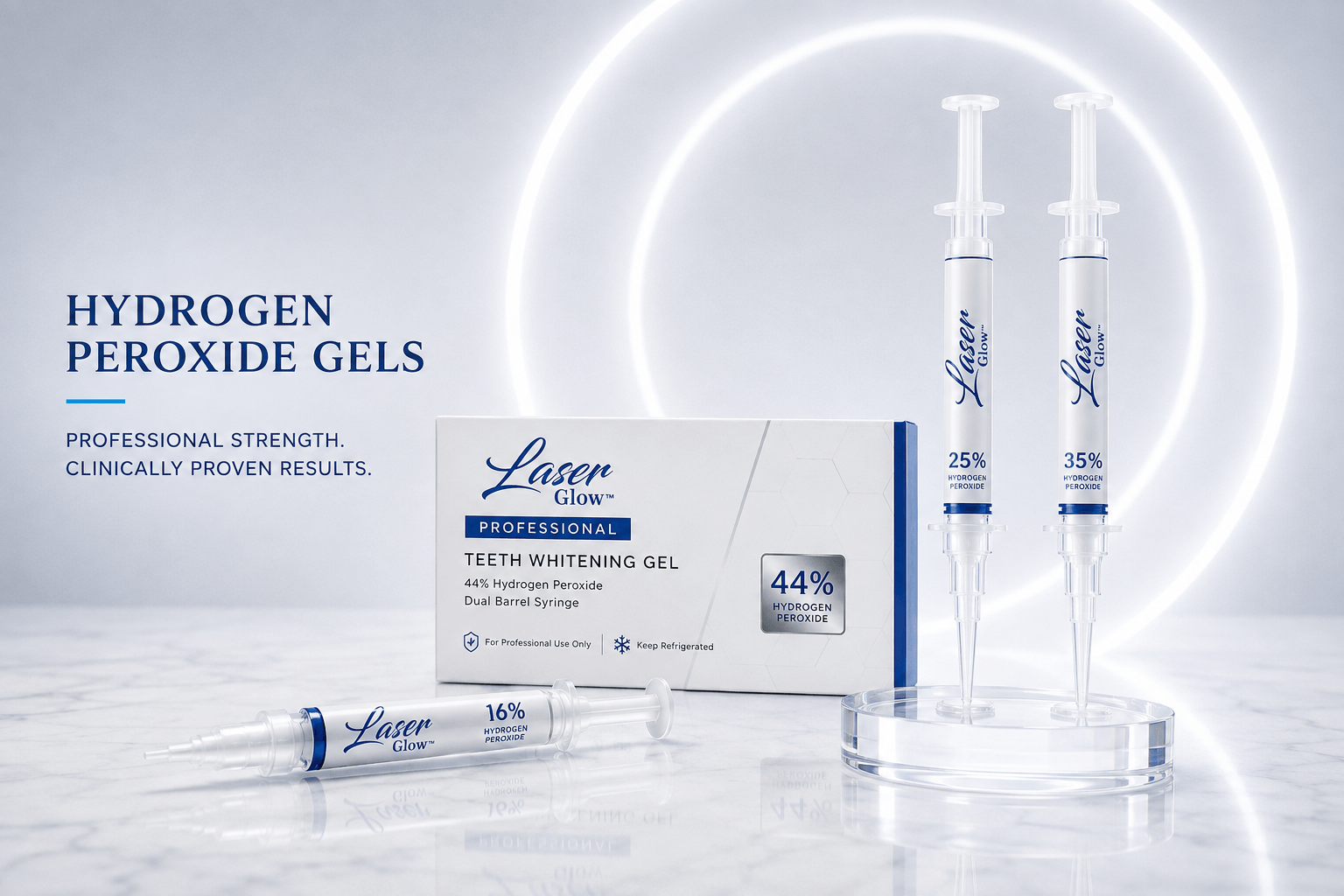
| LaserGlow format | 16%, 25% and 35% single syringes; 36% and 44% dual-barrel. Professional use only | 44% CP whitening pen for client maintenance between sessions |
Every LaserGlow professional HP gel is used with a gingival barrier, and at 35% and above that barrier is mandatory.
Reading the label
Why a CP percentage is not an HP percentage
This is where most carbamide peroxide vs hydrogen peroxide confusion starts. The same number on an HP label and a CP label does not mean the same amount of active peroxide on the tooth.
Carbamide peroxide % × roughly one-third ≈ active hydrogen peroxide %Example: a 36% carbamide peroxide gel contains roughly 12% active hydrogen peroxide. A rule of thumb for understanding labels, not a substitution formula.
Use it to read labels
The conversion explains why a high CP number on a take-home product is not the same as a high HP number on a chairside syringe. It helps you talk clients through the difference.
Don’t use it to swap products
Release pattern, pH, delivery format and contact time all differ between finished products. Never build a homemade equivalence and change a protocol to match it. Follow each product’s own instructions.
What the evidence says
Which causes less sensitivity: hydrogen or carbamide peroxide?
On sensitivity, the carbamide peroxide vs hydrogen peroxide answer is simple: both can cause it. The American Dental Association lists temporary tooth sensitivity and gum inflammation as common side effects of whitening, whichever agent is used. Concentration, contact time, application quality and the client’s own history drive the risk more than the name of the agent.
A 2024 systematic review found limited evidence that one particular in-office carbamide peroxide protocol may whiten about as well as a compared hydrogen peroxide protocol with less sensitivity. The authors called for better trials. That is a signal worth knowing, not proof that every CP product is gentler than every HP product.
What reduces sensitivity in practice
- Screening for recession, exposed dentin and sensitivity history before choosing a product
- Matching concentration to the client rather than defaulting to the strongest gel
- Complete soft-tissue isolation and a thin, controlled application
- Staying within the labeled contact time and offering aftercare such as a desensitizing gel for teeth
For sensitivity-first planning, see teeth whitening for sensitive teeth.
For providers
Hydrogen peroxide or carbamide peroxide: how to choose
- Start with the finished productRead the intended use, concentration, delivery system, contact time, storage directions and contraindications, not just the agent name.
- Match the settingA chairside appointment and a take-home program need different controls and different client behavior.
- Assess the clientSensitivity history, gum condition and oral-health concerns can change the plan or call for dental evaluation first.
- Set restoration expectationsNatural teeth may lighten while crowns, veneers and bonding stay the same shade.
- Stay within scopeUse only products and procedures permitted for your role. Confirm the rules in your state.
- Plan maintenanceMany providers use HP chairside and CP for at-home upkeep. See the 44% carbamide peroxide guide. For a consumer-friendly overview of strengths and safety, see carbamide peroxide teeth whitening.
Choosing HP? Strength selection is covered in hydrogen peroxide whitening gel strength. Weighing a peroxide-free third option? PAP+ is compared with both peroxides in PAP vs peroxide whitening.
FAQ
Carbamide peroxide vs hydrogen peroxide FAQ
Quick answers about the two peroxides. Product question? Contact our pro team.
Is carbamide peroxide the same as hydrogen peroxide?
No. Carbamide peroxide is a precursor that breaks down into hydrogen peroxide and urea in the presence of water, releasing HP gradually.
Hydrogen peroxide is the direct agent; CP is a slower way of delivering it.
Is carbamide peroxide weaker than hydrogen peroxide?
At the same label percentage, CP delivers less active peroxide: roughly one-third of its concentration becomes HP.
That makes the numbers incomparable, so judge finished products by their instructions and intended use, not by the largest number.
Which works faster?
Hydrogen peroxide, because it is directly active. Carbamide peroxide releases HP over time.
Actual performance still depends on the complete product and protocol.
Which causes less sensitivity?
Both can cause temporary sensitivity. Concentration, contact time, application and the individual matter more than the agent alone.
Evidence does not support a sensitivity-free claim for either one.
Can hydrogen peroxide and carbamide peroxide be mixed or swapped?
No. Don’t combine agents outside a product’s tested formula, and don’t substitute one for the other at the same percentage.
Follow each product’s own instructions and timing.
Do either whiten crowns or veneers?
No. Both work on natural teeth only. Restorations keep their shade.
Picked your peroxide?
Shop professional hydrogen peroxide gels from 16% to 44%, or review the full three-agent comparison. For trained providers. Follow product instructions.