Provider buying checklist
What makes the best teeth whitening gel for a professional service? Seven things you can check before you buy: formulation, concentration accuracy, syringe design, barrier compatibility, storage, shelf life and supplier support. This checklist shows what a strong gel looks like on each point, and the red flags that should stop an order.
Short answer: the best teeth whitening gel is the one that performs predictably in your protocol, not the highest percentage. Judge quality first, then match strength to each client.

How to evaluate whitening gel quality
The best teeth whitening gel checklist: 7 quality checks
Whether you call it the best whitening gel or the best teeth bleaching gel, the answer for a professional service is not the biggest number on the syringe. It is the gel that behaves the same way every appointment, inside a protocol you can document and defend.
| Check | What a strong gel shows you | Red flag |
|---|---|---|
| 1. Formulation | Active agent, professional-use labeling and written instructions for the exact product | Vague ingredient claims or no instructions in the box |
| 2. Concentration accuracy | A stated percentage you can match to a protocol, plus a range of strengths | One “extra strong” formula sold for every client |
| 3. Syringe design | A defined fill volume, a clean dispensing tip and a stated client yield | No volume on the label or no yield guidance |
| 4. Barrier compatibility | A matched gum barrier and clear isolation requirements | No mention of soft-tissue protection |
| 5. Storage | Published storage directions, including refrigeration where needed | “Store anywhere” or no directions at all |
| 6. Shelf life | A printed expiration date and lot number on every unit | Unlabeled syringes or repackaged stock |
| 7. Support | Protocol guides, training and a team that answers product questions | A checkout page and nothing after it |
Score any supplier you are considering against all seven. A gel that fails one check is a gel you will be troubleshooting chairside.
Checks 1 and 2
Concentration accuracy: what teeth whitening gels used by dentists get right
What to read on the label
Start with the finished product, not ingredient shorthand. A professional gel should state its active agent and concentration, who it is intended for and how it is used. Formula details such as pH, viscosity and delivery system change how the gel handles chairside, so the instructions for that exact product matter more than a generic percentage.
Percentages are not interchangeable across brands or across agents. A hydrogen peroxide gel and a carbamide peroxide product with similar numbers behave differently; see carbamide peroxide vs hydrogen peroxide for why.
Where strength fits
Quality first, then percentage
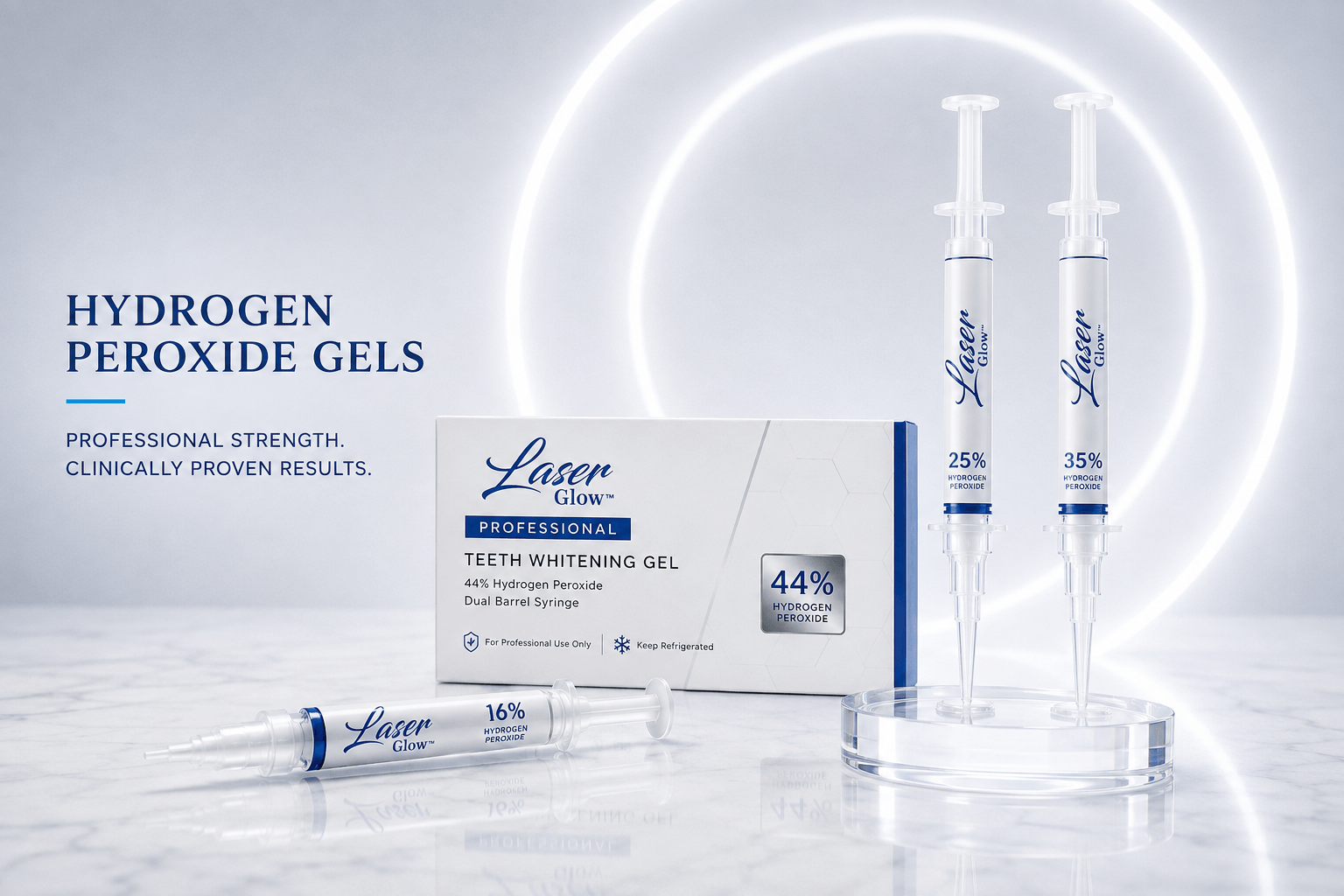
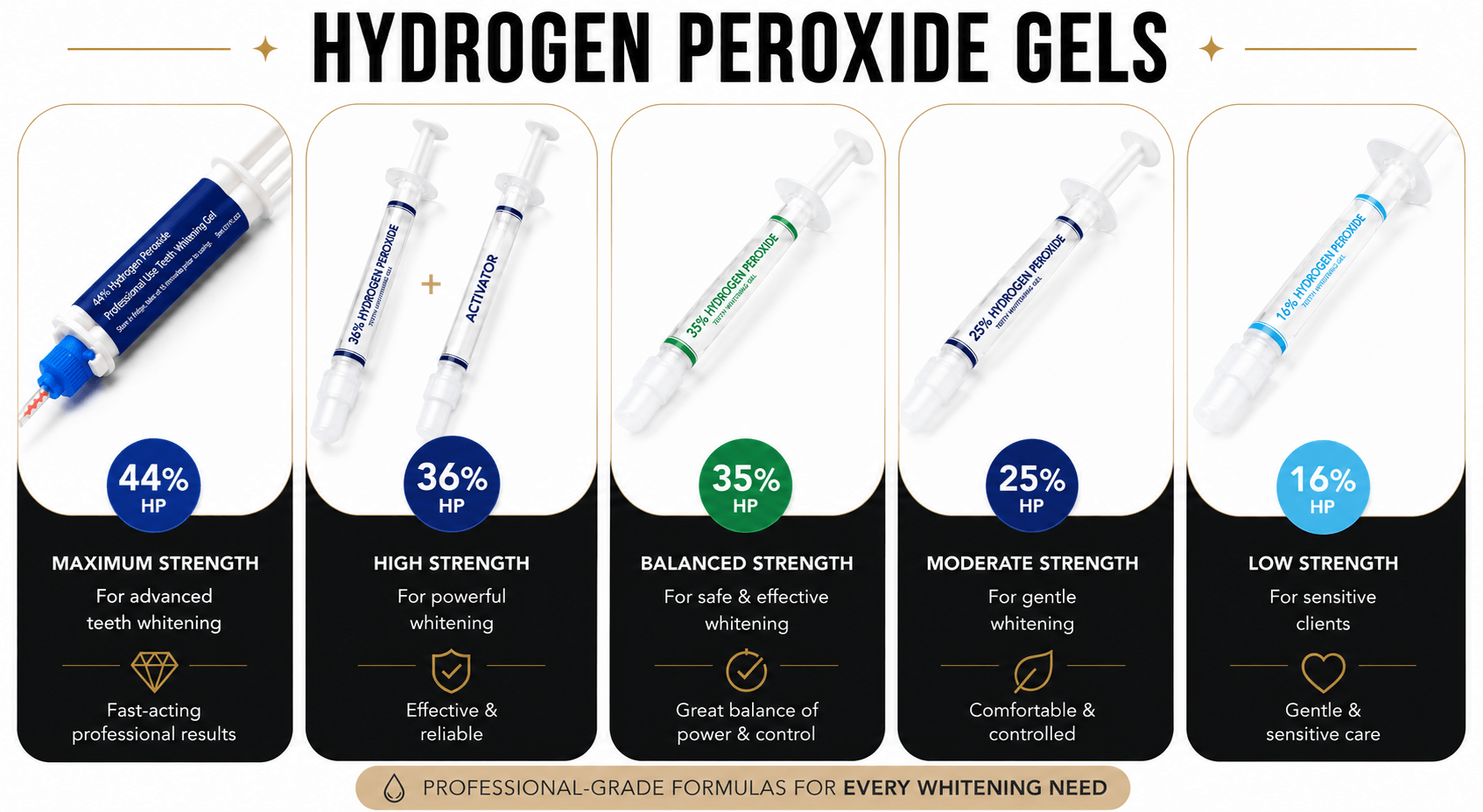
Once a supplier passes the quality checks, strength becomes a case-by-case decision based on sensitivity history, stain type, your isolation routine and your scope. LaserGlow carries 16%, 25%, 35%, 36% and 44% hydrogen peroxide so you can match the case instead of forcing one gel onto every client.
The full selection framework lives on one page: hydrogen peroxide whitening gel strength.
Considering a peroxide-free option for some clients? Compare PAP vs peroxide whitening before you add a second chemistry to your menu.
Check 3
Syringe design and how many clients each unit treats
The syringe decides how cleanly gel reaches the tooth and how much ends up in the bin. Look for a defined fill volume, a tip that lets you lay a thin, even layer on the facial surfaces, and a yield figure you can plan around.
A stated yield is a quality signal in itself: it tells you the supplier has measured controlled use, and it lets you cost each appointment before you buy. Format trade-offs are covered in dual-barrel vs single-syringe whitening gel, and the yield math in how many clients per whitening gel syringe.
Check 4
Barrier compatibility and soft-tissue isolation
Why it belongs on a gel checklist
Peroxide that reaches unprotected gum tissue can cause temporary irritation or blanching. A supplier that takes this seriously sells a compatible light-cured barrier and tells you exactly when it is required.
Every LaserGlow professional HP gel, 16% through 44%, is used with a gingival barrier. From 35% upward it is mandatory, with no exceptions for experienced providers.
What to confirm before you buy
- The barrier is compatible with the gel and with your curing device
- The instructions say when the barrier is required and how coverage is checked
- Retraction and moisture control are part of the published protocol, not an afterthought
New to barriers? Start with what is a gingival barrier, then the full soft tissue isolation teeth whitening protocol.
Checks 5 and 6
Storage directions, shelf life and traceability
-
05
Published storage directions
Peroxide is chemically active, so heat, light and time all wear it down. The best whitening gel comes with storage directions for that exact strength. LaserGlow’s 36% dual-barrel gel, for example, is labeled for refrigeration at 35–46°F (2–8°C) and should not be frozen.
-
06
Expiration date and lot number
Every unit should carry a printed expiration date and lot. Old gel can look normal in the syringe while its active ingredient has weakened, which shows up as flat, unpredictable results rather than an obvious defect.
-
✓
Sealed, undamaged packaging
Cracked, leaking or unsealed syringes should never reach the treatment room. A supplier that ships professional gel should also tell you what to do when a delivery arrives warm.
-
✓
Order size that matches your schedule
Buying more than you can use before the date wastes money. Plan reorders from your real appointment volume and the stated yield per syringe.
Check 7
Supplier support, training and room to grow
The gel is only as good as the system around it. Look for documentation and people, then watch for the six red flags that mark a weak supplier.
Protocol guides
A written protocol for each strength covering screening, isolation, timing and aftercare.
Professional teeth whitening guide →Training
Structured education so every provider on the schedule runs the gel the same way.
Teeth whitening certification →Volume pricing
A path to buy at volume when you add chairs, locations or resale.
Wholesale teeth whitening gel →Your own brand
The option to put the same professional gel under your own label later.
Private label teeth whitening →Six supplier red flags
Results promises
Claims of a set number of shades or a fixed outcome. Results vary by client, stain and restorations.
Sensitivity-free claims
Sensitivity can occur at any concentration. A credible supplier says so plainly.
Pro strength sold for home use
Professional HP gels are chairside products for trained providers, not tray or take-home refills.
No barrier guidance
Any professional peroxide gel sold without isolation instructions is a liability.
Missing dates
No expiration or lot on the unit means no way to trace a problem back to its batch.
Nobody to call
If you cannot get a product question answered before you buy, you will not get one after.
Running whitening in an aesthetic practice? See the best teeth whitening gel for med spas for scope and service-menu questions. Professional use only; confirm the rules in your state for your provider type.
FAQ
Best teeth whitening gel FAQ
Quick answers for providers comparing gels. Product question? Contact our pro team.
What is the best teeth whitening gel for professionals?
The one that passes all seven checks: clear formulation, an accurate stated concentration, a well-designed syringe with a stated yield, barrier compatibility, published storage, a printed expiration date and real supplier support.
Strength comes after that, matched to each client. See hydrogen peroxide whitening gel strength.
Is the strongest whitening gel the best?
No. Higher concentration can increase sensitivity and soft-tissue risk, and it leaves less margin for error in isolation.
Choose the lowest strength that can realistically reach the client’s goal with the isolation and experience you have.
Can whitening gel percentages be compared across brands?
Not reliably. Active agent, pH, formula design, delivery system and instructions all change how a gel is used.
Compare finished products and their directions, not label numbers alone.
Does a good whitening gel need a gingival barrier?
With LaserGlow professional hydrogen peroxide gels, yes. A barrier is used with every strength from 16% to 44% and is mandatory at 35% and above.
Follow the gel and barrier instructions for placement, curing and coverage checks.
Will a stronger gel whiten crowns or veneers?
No. Whitening changes natural teeth, not crowns, veneers or bonding.
Screen for restorations and discuss possible shade mismatch before treatment.
How do I know if whitening gel has gone bad?
Check the printed expiration date first, then the seal, color, texture and how the gel dispenses.
Appearance alone cannot confirm active strength, so replace anything past its date. Details: does teeth whitening gel expire.
Stock gel that passes every check
Professional hydrogen peroxide gels from 16% to 44%, with stated yields, published storage directions and the barrier each one needs. For trained providers. Use as directed.