Wireless LED Whitening Kit
A reusable LED device paired with whitening gel. Keep the hardware, gel and replacement products on their own storage and expiration schedules.
View LED Kit →
Teeth whitening gel can lose strength over time, and using an old tube or syringe may leave you with weaker or less predictable results. Peroxide-based whitening products work best when they are fresh, sealed and stored according to the exact product label.
If you have gel from a past whitening kit, whitening pen or professional order, check the expiration date, packaging and storage directions before use. Replace the product when it is past its printed expiration date or when its seal, texture, color, odor or packaging has changed unexpectedly.
Yes. Hydrogen peroxide, carbamide peroxide and other active whitening formulas have a limited shelf life. The gel may remain inside the syringe after its active ingredients have weakened. Use the printed expiration date and storage directions for the exact product rather than relying on a universal timeline.
Most bleaching gels rely on hydrogen peroxide or carbamide peroxide. These ingredients are chemically active, which allows them to interact with colored compounds in natural teeth. That activity also means their stability can be influenced by time, temperature, light, pH, packaging and contamination.
Whitening gel does not spoil like food, but the active peroxide can gradually decompose. If less active ingredient remains in the syringe, the product may whiten more slowly or produce disappointing results even when it is worn for the recommended time.
Hydrogen peroxide is the direct bleaching agent and is generally associated with faster activity. Carbamide peroxide breaks down and releases hydrogen peroxide more gradually. Both types can expire, and their usable life depends on the specific formula, concentration, stabilizers, packaging and manufacturer testing.
A package feeling warm when delivered does not, by itself, prove that the gel is unusable. Stability depends on the formulation, temperature, exposure duration and packaging. Check the product label and contact LaserGlow when a temperature excursion is uncertain.
The expiration date is the first thing to check, but storage or package damage can compromise a product before that date. No visual inspection can measure active peroxide concentration, but these findings are reasons to stop and verify the product rather than continue using it:
Cold gel may temporarily become thicker and harder to dispense. Follow the label’s acclimation instructions before deciding that normal cold-related viscosity is a defect. Never force a syringe or heat it in hot water.
The most common problem is weaker or inconsistent whitening because the active ingredient has degraded. You may complete the treatment time and see little improvement. If the gel’s texture, pH, packaging or handling characteristics have also changed, its behavior can become less predictable.
Do not apply extra gel or extend the treatment to compensate for suspected loss of strength. More product can overflow onto the gums, and longer contact can increase sensitivity or soft-tissue irritation without restoring the formula’s original activity.
Rinse your mouth and stop the treatment if irritation occurs. Seek dental or medical guidance if symptoms persist. Contact Poison Control or seek urgent guidance when more than a small incidental amount is swallowed or the exposure is uncertain.
The question “does teeth whitening expire?” applies to more than gel syringes. Whitening strips, pens and complete kits can all become less effective over time, but the warning signs differ.
A reusable LED device paired with whitening gel. Keep the hardware, gel and replacement products on their own storage and expiration schedules.
View LED Kit →A brush-tip whitening pen for targeted application and compatible tray routines. Follow the printed expiration and storage instructions.
View CP Pen →Individually packaged 6% hydrogen peroxide strips. Check each sealed treatment and the expiration printed on the box.
View Whitening Strips →PAP+ and violet color-correcting strips with product-specific storage and expiration directions.
View Purple Strips →Post-whitening care with potassium nitrate, calcium phosphate and sodium fluoride to support comfort after treatment.
View Aftercare Gel →Professional hydrogen peroxide gels require product-specific control from receiving through treatment. Clinics and studios should track the product, concentration, lot, expiration, package condition, opened date when applicable and any temperature excursion.
Use this table as a reference to LaserGlow’s currently published online directions. Always check the package received with the order because formulations, packaging and labels may be updated. The current product label controls if it differs from general online guidance.
| LaserGlow professional gel | Published storage direction | Before use |
|---|---|---|
| 36% HP dual-barrel gel | Refrigerate at 35–46°F (2–8°C). Do not freeze. Keep away from direct sunlight and heat. | Remove from refrigeration approximately 10–15 minutes before use for normal viscosity and flow. |
| 44% HP dual-barrel gel | Refrigerate and avoid heat exposure. Keep the syringe stored according to its label. | Allow it to sit for the time stated on the current product label before dispensing. |
| 35% HP syringe | Keep refrigerated or in a cool location. Keep sealed and avoid prolonged heat or direct sunlight. | Follow the current package directions before professional application. |
| 16% HP and 25% HP syringes | Follow the storage conditions printed on the specific shipment. Keep sealed and avoid preventable heat and sunlight. | Do not import instructions from another concentration, formula or brand. |
| PAP+ and non-peroxide formulas | Follow that formulation’s exact label. Peroxide-free formulas also have product-specific shelf-life requirements. | Check expiration, appearance and package integrity before use. |
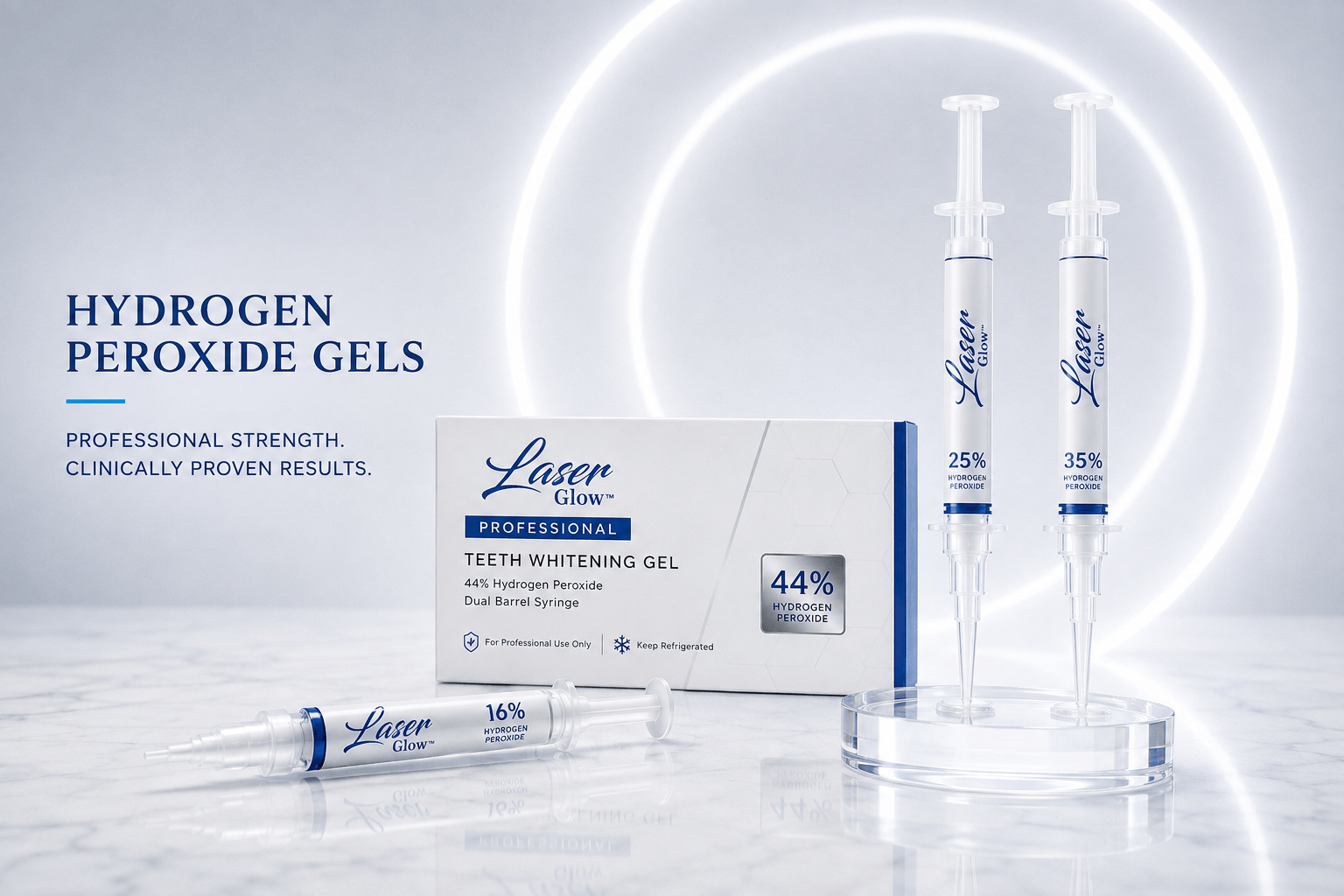
LaserGlow professional 16%–44% hydrogen peroxide gels are intended for trained providers following applicable laws, product instructions, client screening, soft-tissue isolation and professional protocols. They are not consumer refill gels.
Review LaserGlow’s professional single- and dual-barrel hydrogen peroxide gel formats.
Shop Professional Gels →Compare concentrations, delivery formats and professional workflow considerations.
Open Gel Guide →Explore professional equipment, multiple gel strengths, isolation supplies and disposables.
View Professional Kit →There is no universal shelf life. Use the expiration date and storage instructions printed on the exact product. Formula, concentration, packaging and manufacturer stability testing all matter.
There is no universal opened-syringe period. Keep the product stored as directed, recap it correctly and follow any opened-use period printed on the label.
Some formulas require refrigeration while others permit cool room-temperature storage. Follow the exact label. LaserGlow’s professional 36% and 44% HP dual-barrel gels have published refrigeration directions.
Do not use it until the product-specific exposure has been evaluated. Temperature, time, packaging and formula determine the significance. Record the exposure and contact the supplier.
Do not freeze whitening gel unless its manufacturer explicitly permits it. Quarantine a product that has frozen and request product-specific guidance.
Check the expiration, lot, seal and packaging. Unexpected leakage, separation, color, odor or viscosity changes are reasons to stop. Appearance alone cannot confirm active peroxide strength.
Yes. Check their printed expiration and sealed packaging. Strips may dry out or lose adhesion, while pens may clog, leak or dispense inconsistently.
This guide provides general educational information. Follow the current label for the exact product in hand. Contact LaserGlow support for product-specific storage questions and seek dental or medical guidance for persistent symptoms or significant exposure.
Your cart is currently empty.
Not sure where to start?
Try these collections: