LED whitening science
Does LED teeth whitening work? Yes, but the peroxide gel does the whitening, not the light. Research suggests the light adds little measurable color change on its own. Here is the chemistry, what studies show, how LED compares with laser, and what changes between office and home.
Short answer: LED whitening works because of the peroxide gel. The light may speed the reaction slightly, but systematic reviews find little added color change from light alone.
The verdict
Does LED teeth whitening work? Yes, because of the gel
Does LED light whiten teeth? Not on its own. Here is the one-paragraph answer before the chemistry.
What does the whitening
LED teeth whitening uses a light-emitting diode, typically in the blue spectrum, aimed at teeth coated with a peroxide whitening gel. Any whitening happens through that gel. Without an active peroxide gel, light exposure alone does not whiten teeth.
So the treatment works. The real question is how much the light contributes beyond the gel.
What the light adds
Possibly speed, not whitening power
The usual rationale is that light may help speed up a reaction already happening in the gel. Several systematic reviews have found the added benefit to be minimal. Light does not replace peroxide as the active ingredient.
Why in-office sessions look fast: a professional appointment can show visible change in one visit, while strips or trays take days or weeks. The bigger driver is the much higher peroxide concentration applied under professional supervision, not the light.
The science
How does LED teeth whitening work? The chemistry
LED teeth whitening science comes down to oxidation chemistry in the gel.
Peroxide gel + contact time on natural enamel = whiteningLight is a possible accelerator in that equation, not a term on its own.
- Peroxide breaks downHydrogen peroxide breaks down into water and reactive oxygen species through oxidation. Carbamide peroxide releases hydrogen peroxide first.
- Oxygen species move through the toothThey penetrate enamel and dentin, where the discoloring pigment molecules sit.
- Pigments are broken apartLarge, colored molecules are split into smaller ones that reflect less color, so the tooth looks lighter.
- Light adds energy, in theoryThe light is meant to add energy that could speed up peroxide breakdown. The reaction happens with or without light; it is simply slower without it.
Different agents release their active ingredient differently, which is why percentages are not interchangeable. See carbamide peroxide vs hydrogen peroxide, or compare all three chemistries in PAP vs peroxide whitening.
The research
Do teeth whitening lights work? What studies show
This is the most contested question in professional whitening.
The weight of evidence leans skeptical
Several systematic reviews and meta-analyses of randomized controlled trials, including a widely cited 2018 review in the Journal of Dentistry, have found that light activation does not meaningfully improve color change compared with the same peroxide gel used without a light, at lower or higher concentrations.
What the research agrees on: light does not replace peroxide, and any product claiming the light alone whitens teeth without an active gel is not telling the truth.
Why lights are still used
LED-based protocols earn their place through appointment structure and supervision. A provider guiding a client through a controlled, professional-strength session in one visit has real value, however much the light itself contributes chemically.
Some gels are also formulated and labeled for use with a light, so the protocol follows the gel manufacturer’s instructions.
Side effects and safety are covered in our blue light teeth whitening guide.
LED vs laser and other myths
What light-based whitening can and can’t do
“Laser whitening” is usually LED
True laser whitening exists but is rare, specialized equipment. Most services sold as laser whitening use LED arrays, because “laser” sounds more advanced. Both rely on the same peroxide reaction. Ask which device is actually used.
“The laser burns away stains”
Nothing is burned or removed. The light is meant to accelerate an oxidation reaction in the gel: a chemical process, not heat or ablation.
“Brighter light means whiter teeth”
Beyond a certain intensity, more output doesn’t meaningfully speed the reaction. Concentration and contact time matter more than brightness.
“It works on any tooth”
It works on natural enamel with surface staining. Veneers, crowns and bonding don’t respond to peroxide, and severe intrinsic discoloration from medication or trauma responds slowly.
“One session lasts forever”
No whitening method is permanent. Results commonly hold 6 to 18 months as new surface stain builds. See why teeth whitening results fade.
“Any LED light will do”
Use light only with a gel designed for it and a matched device. A consumer light or a curing light is not a substitute for the lamp a protocol calls for.
Office vs home
Does LED light whiten teeth at home as well as in the office?
The light matters less than the gel in both settings. What changes is concentration, supervision and time.
| Factor | Professional LED lamp | At-home LED kit |
|---|---|---|
| Gel strength | Professional-strength hydrogen peroxide, provider-applied | Lower concentration, self-applied |
| Light | Higher intensity, full-arch coverage | Lower intensity, mouthpiece-mounted |
| Session | One appointment, typically 45 to 60 minutes of timed rounds | Short sessions repeated over days |
| Supervision | Trained provider | Self-directed; follow product instructions |
| Best for | A faster visible change before an event | Gradual results and maintenance between visits |
At home
At-home kits work gradually because the gel is weaker, not because the light is. The wireless LED teeth whitening kit pairs a lower-strength gel with an LED mouthpiece for maintenance, not as a replacement for a professional session. Weighing the two routes? Read professional vs at home teeth whitening.
For providers
Light follows the gel
Use a light only when the gel calls for one, and let the gel instructions set the timing: how long to leave whitening gel on. Before buying, read how to choose a professional teeth whitening light and compare each teeth whitening machine. Professional use only.
FAQ
Does LED whitening work? FAQ
Quick answers on light, gel and evidence. More questions? Contact our team.
Does LED teeth whitening actually work?
Yes, the treatment works, because of the peroxide gel. Research suggests the light adds little measurable color change beyond the same gel without light.
Does the LED light whiten teeth by itself?
No. Without an active peroxide gel, light exposure alone does not whiten teeth.
Be wary of any product that claims otherwise.
Do teeth whitening lights work better than no light?
Systematic reviews generally find no meaningful difference in color change between the same gel used with and without light.
Some gels are formulated for light activation, so follow the gel manufacturer’s instructions.
Is laser teeth whitening the same as LED teeth whitening?
In almost all cases, what is sold as laser whitening is LED. True laser systems are rare, specialized equipment.
Both work through the same peroxide reaction.
Do at-home LED whitening kits work?
They can brighten teeth gradually with repeated use, because the gel is lower strength than professional gel.
They are most effective as maintenance between professional treatments.
Does LED whitening work on veneers or crowns?
No. Restorations do not respond to peroxide, with or without light.
Put the science to work
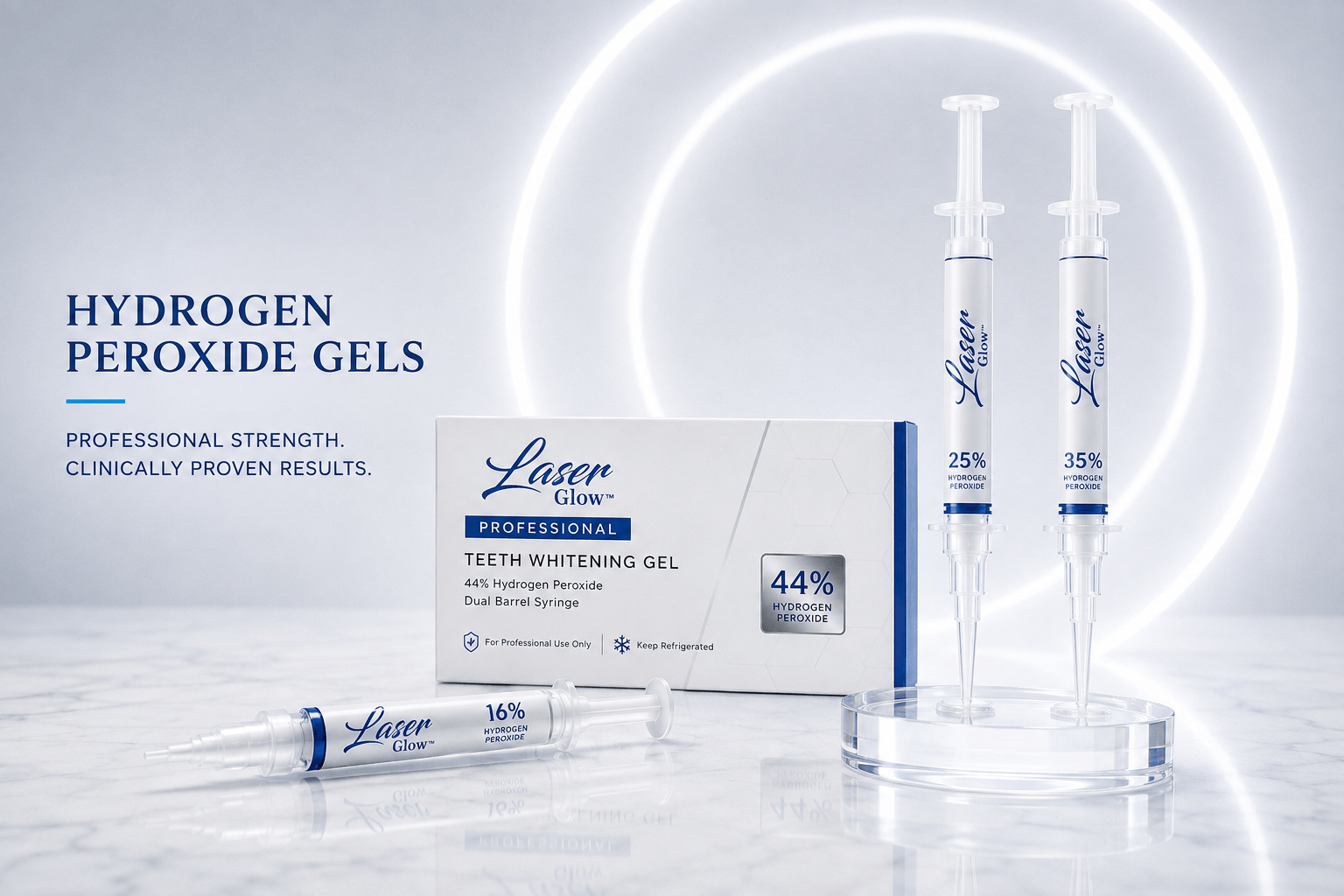
Professional hydrogen peroxide gels from 16% to 44% and LED equipment for trained providers. Follow product instructions.