LED Touch-Screen Teeth Whitening Machine for Clinics, Salons & Medspas
The LaserGlow LED Touch-Screen Teeth Whitening Machine puts the whole session on one screen. A full-colour touchscreen with adjustable power and timer presets means you set a protocol once and repeat it exactly — no guessing at dial positions between clients. Blue LED gel activation, floor-standing and adjustable, built for dental clinics, med spas, salons and mobile whitening studios.
1996 in stock
FREE PDF Teeth Whitening Pro Guide
FREE PDF Teeth Whitening Pro Guide
📘 Free Professional Whitening Protocol (PDF)
The official LaserGlow Whitening Protocol & Safety Guide used by dental clinics and med-spas. Clear chairside steps, isolation guidance, and comfort tactics to deliver consistent results.
If the email isn’t in your inbox within a few minutes, please check your Spam or Promotions folder.
Share this product

The Whole Session, on One Screen
A full-colour touchscreen replaces the dial. Set power and timer presets once, run the identical protocol on every client, and adjust mid-session without stopping the exposure. That is what separates this unit from a hand-set lamp — not the light, the control.
Used across dental clinics, med spas, salons and mobile whitening studios.

Touch Control, Explained
The lamp underneath is blue LED, same as every professional unit in this range. The touchscreen is the reason this machine costs more than a machine with hand-set dial or knob controls, so here is exactly what it does — not marketing language, the actual function.
Set once, repeat exactly
Save a power and timer combination and select it by name next time. No matching a dial position from memory, no drift between clients.
Change mid-session
If a client reports sensitivity, adjust power or time from the screen without restarting the exposure cycle. A hand-set control forces a full restart.
Consistent across staff
Training a second operator is a screen selection, not tacit knowledge passed dial-turn to dial-turn. Two technicians running the same preset get the same exposure.
An Arm That Goes Where You Put It
The lamp head sits on a flexible gooseneck arm rather than a fixed mount. That distinction matters more than it sounds — a fixed lamp dictates where the client's head goes; a flexible arm adapts to the client instead.
Bend the arm to match however the chair or treatment bed is reclined, instead of asking every client to sit at the same fixed angle a stationary lamp requires.
Move the head slightly mid-session if a client shifts, without dismantling the setup or losing your position entirely.
Folds down against the rolling stand between sessions, so it does not dominate a treatment room the way a rigid overhead arm does.


Inside the Lamp Head
Professional whitening gel contains hydrogen or carbamide peroxide, which breaks down on its own even without light. What the lamp does is speed that breakdown up, which is the difference between a chairside session and hours in a take-home tray.
The blue LED array in this head sits in the 460–480 nanometre range. That specific band matters because the photoinitiators formulated into professional gels are tuned to absorb blue light — not any visible light, blue specifically. It is cold LED, so it produces very little heat at the tooth surface, and it emits no UV.
This is also why a laser is not used for whitening activation, even though the terms get used interchangeably in casual conversation. A laser is a narrow coherent beam; whitening needs broad, even coverage across the whole smile zone, which is what an LED array is built to do and a laser is not.
Why Digital Presets Beat Manual Controls
Most providers do not start with a digital-control lamp. They start with a machine that is set by hand for every client — a dial or knob you turn and remember, a shared dental bleaching lamp between operatories, or a system inherited secondhand. This is what changes when in-office teeth whitening runs on saved presets instead of a hand-turned dial or knob.
✕A dial position is a guess reconstructed from memory, client to client.
✓A saved preset is exact. Select it by name and the exposure matches, every time.
✕Reducing power mid-session usually means stopping and restarting the exposure clock.
✓One tap adjusts power or time. The timer keeps running, the client stays comfortable.
✕Dial positions live in one technician's memory and leave when they do.
✓Presets live on the screen. A new hire runs the identical protocol on day one.
LED Touch-Screen Machine Specs
Digital control across the whole session, on a floor-standing unit sized for a treatment room.
What Ships With the Machine
Everything needed to set the unit up and run your first session. Whitening gel, gingival barrier and retractors are consumables and are ordered separately.
- ✓LED touch-screen whitening lamp
- ✓Flexible gooseneck arm, floor-standing stand
- ✓2 × protective goggles
- ✓Power supply and connection kit
- ✓Quick-start guide and manual

Running the Appointment, and Comparing the Range
The lamp covers one step of the protocol. A clean result depends on the steps either side of it.
Contraindications first, then record the starting shade before anything else.
15–30 minutes depending on the gel. Follow the manufacturer's timing, not the machine's maximum.
Final shade documented, aftercare explained.
Compare the Range
Salons and mobile technicians running a handful of appointments a week.
View machine →Studios that want repeatable digital control and multiple operators running the same protocol.
Dental offices and studios running back-to-back volume.
View machine →Training is sold separately, and it matters
The LaserGlow Online Teeth Whitening Certification Course covers the full protocol across 8 modules and 34 lessons — screening, isolation, application, timing and aftercare. Requirements for who may offer whitening services vary by state and country; verify what applies where you operate.
LED Teeth Whitening Machine FAQ
Everything providers ask before adding a touch-screen unit to their whitening service.
What does the touchscreen actually change?
Repeatability. Adjustable power and timer presets mean you set a protocol once and reproduce it exactly on every client, rather than matching a dial position from memory. It also makes handing the machine to a second operator far simpler, since the protocol is a screen selection instead of tacit knowledge.
What wavelength does this LED whitening machine use?
Blue LED in the 460 to 480 nanometre range — the standard activation band for professional whitening gels. Photoinitiators in peroxide gels absorb in blue, which is what accelerates the reaction. This is cold LED with no UV output.
Is an LED whitening machine the same as a laser whitening machine?
No. LED lamps emit a broad band of blue light across the whole smile zone, while a laser emits a narrow coherent beam. Nearly all chairside whitening units sold as professional machines — including all three LaserGlow models — are LED, not laser. LED is the standard for this application and produces very little heat at the tooth surface.
Is this the same as the dental bleaching lamp used in dental offices?
Yes. "Dental bleaching lamp" and "teeth whitening machine" describe the same category of equipment — a light source that accelerates a professional peroxide gel. This unit adds digital touchscreen control to that equipment, which is the main thing separating it from a basic lamp with hand-set dial or knob controls.
How is the flexible arm different from the Professional LED machine's arm?
This unit uses a flexible gooseneck arm that bends to the angle you need and folds down against the stand between sessions. The Professional LED machine uses a 360° multi-joint articulating arm with dual-arch coverage, built for higher daily volume. Both hold position through a session; the articulating arm offers more positional range for back-to-back appointments.
Which whitening gels work with this machine?
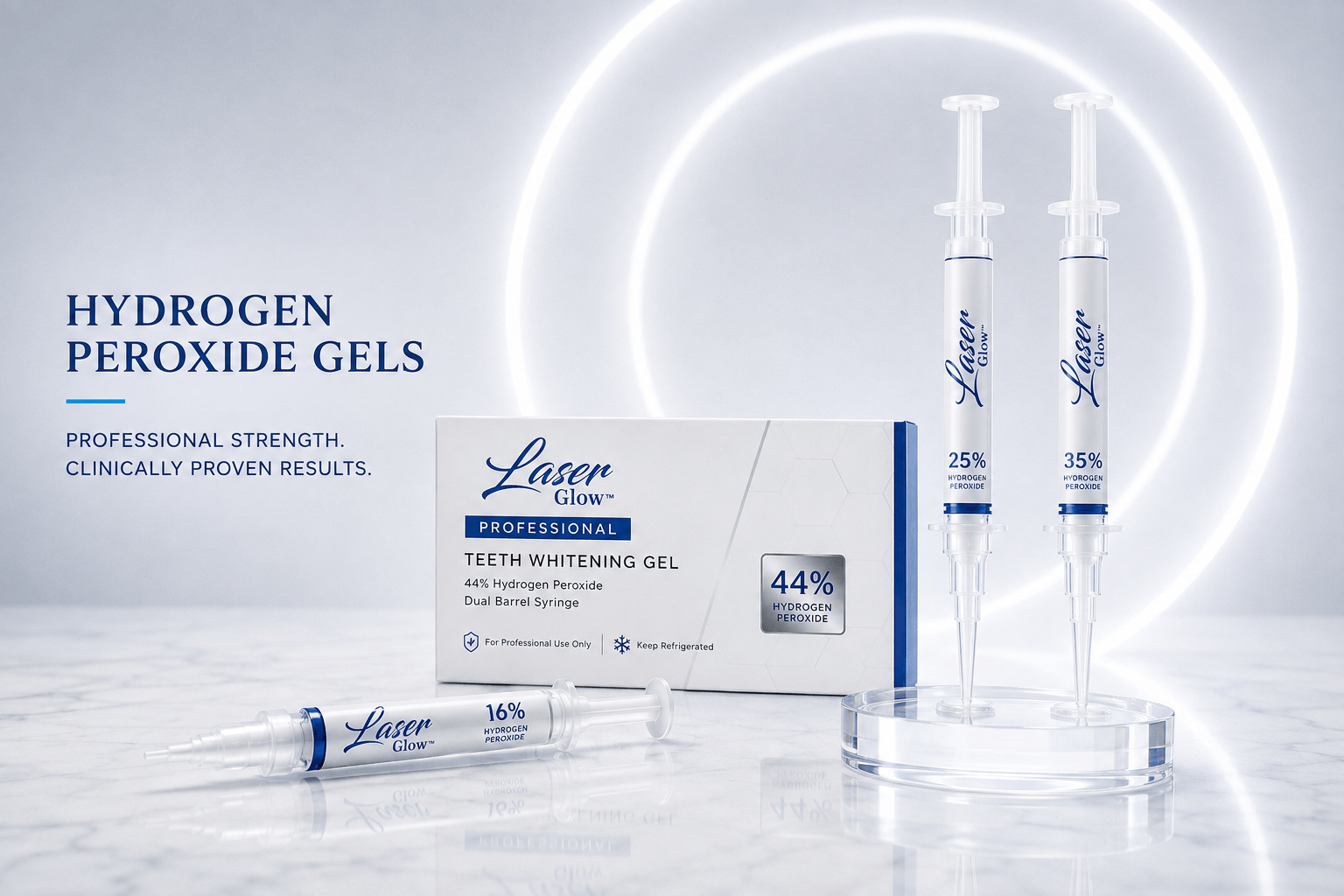
Any professional gel formulated for light activation. That covers hydrogen peroxide at 16%, 25%, 35%, 36% and 44%, 44% carbamide peroxide, and peroxide-free PAP+ formulas. Browse the professional whitening gel range.
How long does a whitening session take?
Active LED exposure typically runs 15 to 30 minutes depending on the gel. A full appointment including screening, isolation, gel application and aftercare usually takes 45 to 60 minutes. Follow the timing the gel manufacturer specifies rather than the machine's maximum.
Is it safe for enamel?
The LED produces very little heat at the tooth surface and emits no UV. Safety in whitening depends mostly on protocol rather than the lamp — appropriate client screening, gingival barrier to isolate soft tissue, protective eyewear, and following gel directions. Existing restorations such as crowns, veneers and bonding do not whiten like natural tooth structure.
Can salons and med spas use this machine?
It is used across dental clinics, med spas, salons, whitening studios and mobile setups. What varies between them is not the equipment but the regulation — who may offer whitening services, and under what supervision, differs by state and by country. Verify the scope-of-practice requirements that apply where you operate before offering services.
Do I need a separate curing light?
Yes, if you use light-cured gingival barrier. This machine activates whitening gel across the smile zone. A handheld curing light is a different device that sets the barrier before gel is applied. Most professional setups need both.
What does it cost to run per client?
The machine is a one-time cost. Recurring spend is consumables — gel, gingival barrier, retractors and goggles. Providers commonly charge $150 to $300 per session, though what you earn depends entirely on your pricing, local demand, marketing and costs. Nothing here is an income guarantee. The teeth whitening business guide has the full breakdown.
Do I need training to use it?
A quick-start guide and manual are included with the machine. For providers working outside a dental setting we strongly recommend structured training — the online certification course covers screening, isolation, application, timing and aftercare. Setup questions can go to our professional team.