Whitening-gel selection is not a contest to choose the highest percentage. The appropriate formula depends on its instructions, the permitted treatment setting, the provider’s training and scope, client-specific risk factors, soft-tissue control, and the desired service plan.
How Should Professional Whitening Gel Strength Be Chosen?
Start with the product’s intended use and instructions, then evaluate the client, provider, setting, isolation requirements, expected contact time, sensitivity history, restorations, oral-health concerns, and prior response. Higher peroxide concentration can increase sensitivity and soft-tissue risk; it does not guarantee a better result for every person or stain type.
Professional Whitening Strengths at a Glance
| Strength tier | Potential planning role | Selection considerations |
|---|---|---|
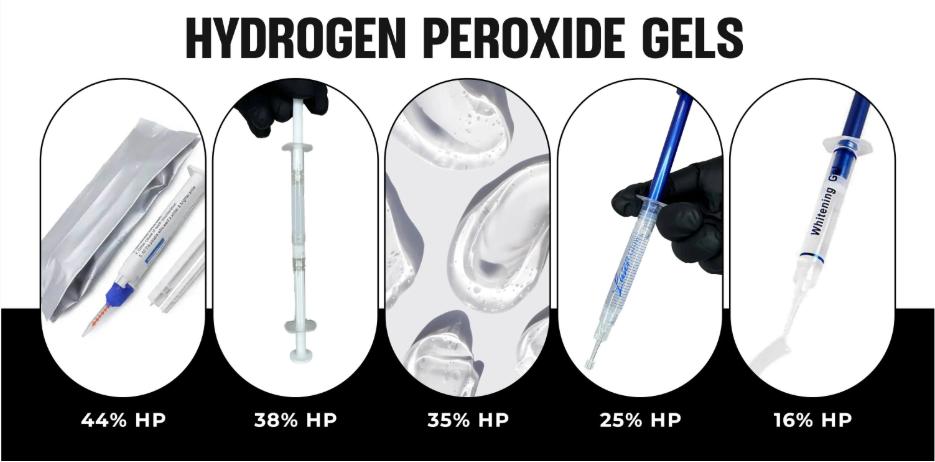
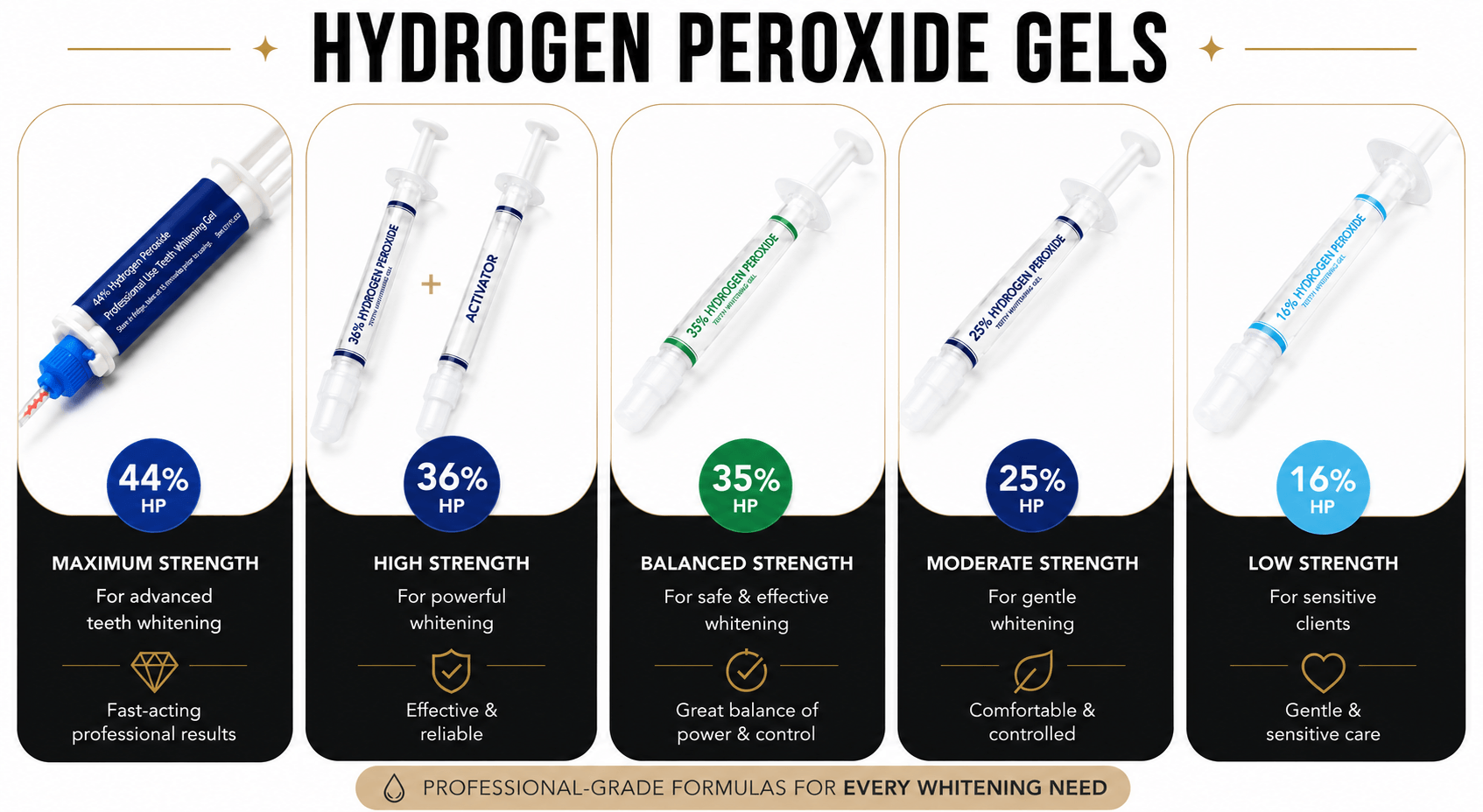
| Lower professional concentration, including 16% HP | Conservative professional starting point or maintenance-oriented protocol where allowed and appropriate. | Sensitivity history, instructions, contact time, isolation, previous response, and realistic expectations. Read the focused 16% HP professional guide. |
| Mid-range professional concentration, including 25% HP | Routine chairside option when it matches the product instructions, setting, provider scope, and client assessment. | Soft-tissue protection, service timing, sensitivity monitoring, and formula compatibility. |
| Higher professional concentration, including 35% HP | Advanced professional protocol—not a default upgrade solely because a client wants faster results. | Training, authorization, strict adherence to IFU, isolation, risk assessment, and contingency planning. |
| Fresh-mix dual-barrel formats, including 36% or 44% HP products | Product-specific advanced delivery system for trained providers where permitted. | Mixing-tip directions, purge and waste specified by the manufacturer, storage, barrier integrity, timing, and experience. Compare dual-barrel and single-syringe delivery. |
These tiers describe selection logic, not universal treatment protocols. Concentrations are not interchangeable across brands, formulas, devices, or delivery systems.
Five Factors That Matter More Than Choosing the Strongest Gel
- Client suitability: oral-health concerns, pain, recession, exposed dentin, restorations, sensitivity history, pregnancy-related questions, and unexplained discoloration may require dental consultation or a different plan.
- Stain and expectation: whitening changes natural teeth; the ADA notes that tooth-colored restorations do not whiten. A higher concentration cannot overcome every biological or restorative limitation.
- Formula instructions: concentration, pH, viscosity, delivery system, contact time, storage, and device compatibility vary.
- Isolation and workflow: controlled placement and soft-tissue protection are essential. A stronger product amplifies the consequences of poor control.
- Provider scope: legal permissions, supervision, education, insurance, and workplace protocols can limit which products and procedures are appropriate.
When to Reassess Instead of Increasing Strength
- The client has pain, significant sensitivity, active irritation, suspected decay, damaged teeth, or unclear oral-health concerns.
- Existing veneers, crowns, fillings, or bonding may create a visible shade mismatch.
- The previous session was not performed according to the formula’s directions.
- Shade was assessed immediately while dehydration could affect appearance.
- The stain type or expectation may not be responsive to external bleaching alone.
- The provider cannot consistently execute the required isolation and documentation.
For the complete provider workflow, use the Professional Teeth Whitening Guide. For chemistry selection before percentage selection, use the HP vs. CP vs. PAP+ comparison.
Professional Whitening Gel Strength FAQs
Is stronger whitening gel always better?
No. Higher concentration may increase sensitivity and irritation risk and does not guarantee a better result. Suitability, formula, instructions, application, contact time, and tooth characteristics all matter.
What strength should a new provider start with?
There is no universal concentration for every new provider. Start with education, local authorization, manufacturer directions, supervised competency where required, and only formulas appropriate to your role and setting.
Can concentration percentages be compared directly across products?
Not reliably. Active ingredient, formula design, pH, delivery system, intended use, instructions, and contact time affect how a product is used.
Will stronger gel whiten crowns or veneers?
No. Whitening affects natural teeth, not tooth-colored restorations. Discuss possible shade mismatch before treatment.
Does a lower concentration guarantee no sensitivity?
No. Sensitivity can occur with whitening at different concentrations. Individual response, existing conditions, product use, and contact time affect risk.