At-home whitening chemistry
Carbamide peroxide teeth whitening uses a compound of hydrogen peroxide and urea that releases peroxide slowly, which is why it is the go-to ingredient for trays, pens and at-home LED kits. Here is how it works, what 10%, 16%, 35% and 44% strengths mean, how to use carbamide peroxide gel and whether it is safe for teeth.
Short answer: Carbamide peroxide whitens teeth by breaking down into hydrogen peroxide over the wear time. Roughly one-third of its percentage becomes active peroxide, so 44% CP is about 15% hydrogen peroxide. Use it as directed, on natural teeth only.
- Releases hydrogen peroxide slowly as it breaks down
- Roughly one-third of the CP % becomes active HP
- Made for take-home trays, pens and LED kits
- Sensitivity can occur; use as directed
The basics
What is carbamide peroxide?
Most at-home whitening gels list carbamide peroxide on the label. Here is what that ingredient actually is.
A carrier for hydrogen peroxide
Carbamide peroxide (CP) is a stable compound of hydrogen peroxide and urea. On its own it does very little to a tooth. Once it meets the moisture in your mouth, it splits back into hydrogen peroxide and urea, and that hydrogen peroxide is what lightens the stain inside enamel.
Because the peroxide is released over time rather than all at once, carbamide peroxide teeth whitening is built around longer, gentler contact: trays, brush-on pens and at-home LED kits.
Why it is used at home
Slow release, more control
A gradual release suits self-applied products, where nobody is isolating your gums or timing the session for you. It is also why carbamide peroxide whitening is measured in days or weeks of routine use, not a single appointment.
Step by step
How does carbamide peroxide work on teeth?
The chemistry is the same reaction used in every peroxide whitening product. Only the delivery is different.
- It meets moistureSaliva and the water in the gel start breaking carbamide peroxide down as soon as it touches your teeth.
- Hydrogen peroxide is releasedThe compound splits into hydrogen peroxide and urea. The peroxide is the active whitening agent.
- Oxygen reaches the stainThe peroxide moves into enamel and dentin and breaks large, colored stain molecules into smaller ones that reflect less color.
- Release continues over the wear timeBreakdown carries on through the contact period, which is why carbamide peroxide whitening gel is worn longer than chairside gels.
The full side-by-side of the two peroxides, including release speed and sensitivity research, is in carbamide peroxide vs hydrogen peroxide. For what any peroxide does to enamel, read is hydrogen peroxide bad for your teeth.
Reading the label
Carbamide peroxide strengths: 10%, 16%, 22%, 35% and 44% compared
Carbamide peroxide percentages look high next to hydrogen peroxide numbers, but they are not measuring the same thing.
| Label strength | Approx. hydrogen peroxide | Typical format | What to know |
|---|---|---|---|
| 10% CP | about 3.5% | Custom trays supplied by a dentist | The most widely studied take-home strength. Usually the longest wear time. |
| 16% CP | about 5.5% | Take-home trays | A middle strength with shorter daily wear than 10%. |
| 22% CP | about 7.5% | Take-home trays and pens | Shorter wear again; sensitivity becomes more likely for some people. |
| 35% CP | about 12% | Short-contact take-home and some in-office products | Short, directed contact times only. |
| 44% CP | about 15% | Brush-on pens and LED kits | Targeted touch-ups and maintenance. Short contact, used exactly as directed. |
Higher is not automatically better. A stronger gel shortens the wear time; it does not guarantee a bigger change, and it raises the chance of sensitivity. The 44% formula used for maintenance between visits is covered in the 44% carbamide peroxide guide.
At home
How to use carbamide peroxide whitening gel
The steps are similar whether your carbamide peroxide gel comes in a pen, a tray kit or an LED kit. Your product’s instructions always come first.
- Start with healthy teethUntreated decay, gum disease or exposed roots should be checked by a dentist before you whiten.
- Brush and dry your teethBrush gently, then dry the front surfaces so the gel stays where you put it.
- Apply a thin layerBrush a thin, even coat on the visible surfaces with a pen, or place a small drop per tooth in a tray. Extra gel mostly ends up on your gums.
- Keep it off your gumsWipe away any gel on the gums or lips. Gum irritation is usually a sign of too much gel or a loose tray.
- Follow the wear time exactlyUse the contact time on your product. Doubling up does not speed results; it mainly adds sensitivity.
- Rinse and wait before staining foodRinse afterwards and follow the product’s waiting time before coffee, tea or red wine.
Using a tray? Compare tray types and fit in teeth whitening trays. Using a retainer or aligner instead? See whitening gel for retainers. Timelines for every format are in how long does teeth whitening take.
Safety
Is carbamide peroxide safe for teeth?
Carbamide peroxide is one of the most widely used at-home whitening agents. Safe use is about strength, wear time and who is using it.
Generally well tolerated when used as directed
Carbamide peroxide teeth whitening is generally considered safe for healthy adults with natural teeth who follow the product directions. The two common side effects are temporary tooth sensitivity and gum irritation, and both are more likely with higher strengths, longer wear or too much gel.
If sensitivity builds, use the product less often or stop, and consider a desensitizing gel. Why it happens and how long it lasts is covered in sensitive teeth after whitening.
Wait or ask first if
- You are under 18. LaserGlow’s whitening products and protocols are written for adults
- You are pregnant or breastfeeding. Read whitening and pregnancy
- You have cavities, gum disease, recession or already sensitive teeth
- Your visible front teeth are crowns, veneers or bonding
Natural teeth only: carbamide peroxide does not change the color of crowns, veneers, fillings or bonding. Read whitening with crowns, veneers or braces before you start. Stop and see a dentist if you get lasting pain, white or sore gums, or sensitivity in one tooth.
Shop by format
Carbamide peroxide gel options from LaserGlow
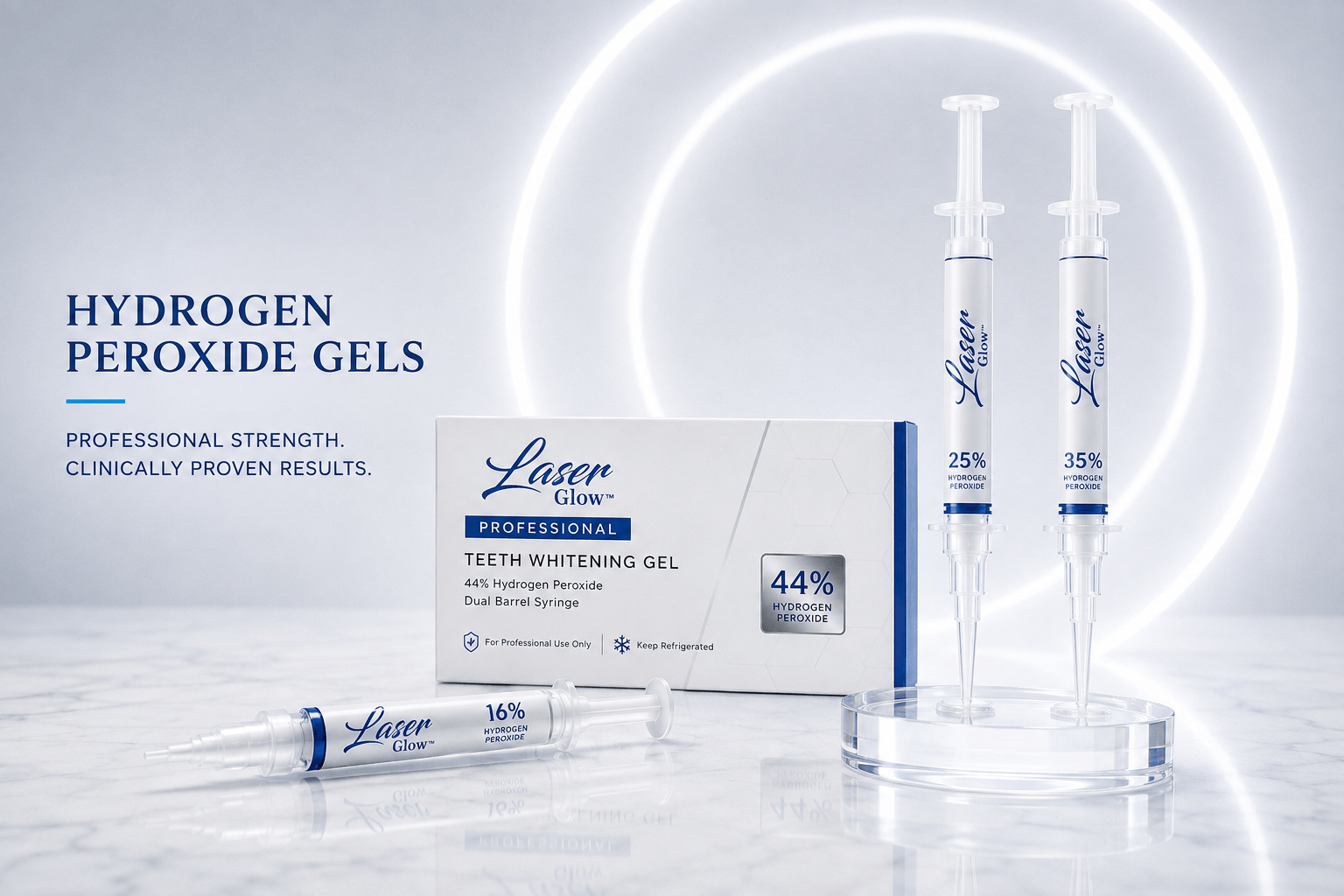
LaserGlow’s at-home whitening pens and LED kits all use 44% carbamide peroxide. Professional 16% to 44% hydrogen peroxide gels are a separate, provider-only category.
44% CP whitening pen
A twist-brush pen for targeted touch-ups and maintenance between whitening treatments. Use as directed. $20.
See the pen →Year supply of pens
A full year of 44% carbamide peroxide pens for ongoing touch-ups, so you are not reordering mid-routine. $65.
See the year supply →LED Teeth Whitening Kit
One 44% carbamide peroxide pen paired with a cordless LED mouthpiece for a timed 16-minute routine. $49.
See the LED kit →Wireless LED kit
One 44% carbamide peroxide pen and six gel pods with a rechargeable blue, red and dual-mode mouthpiece. Sessions run about 16 minutes, and the case sanitizes the mouthpiece with UV. $129.99.
See the wireless kit →Prefer peroxide-free? The PAP+ whitening pen uses a peroxide-free formula. For how PAP compares with both peroxides, read PAP vs peroxide whitening.
FAQ
Carbamide peroxide FAQ
Quick answers about carbamide peroxide gel. Still unsure? Contact our team.
What is carbamide peroxide used for in teeth whitening?
It is the active ingredient in many at-home whitening gels, pens and tray kits. It breaks down into hydrogen peroxide and urea, releasing the peroxide gradually.
Is carbamide peroxide the same as hydrogen peroxide?
No. Carbamide peroxide contains hydrogen peroxide bound to urea and releases it over time. Roughly one-third of its percentage becomes active hydrogen peroxide.
The full comparison is in carbamide peroxide vs hydrogen peroxide.
Is 10% or 35% carbamide peroxide better?
Neither is better for everyone. Lower strengths are designed for longer wear; higher strengths for shorter wear and more chance of sensitivity.
Choose by the product’s directions, your comfort and your dentist’s advice, not by the biggest number.
Is carbamide peroxide safe for teeth?
It is generally considered safe for healthy adults with natural teeth when used as directed. Temporary sensitivity and gum irritation are the common side effects.
Check with a dentist first if you have cavities, gum disease or sensitive teeth, or if you are pregnant.
How long does carbamide peroxide take to whiten teeth?
Results build over days to weeks of routine use rather than in one session. Your starting shade and stain type affect how far natural teeth lighten.
Does carbamide peroxide whiten veneers or crowns?
No. It works on natural teeth only. Crowns, veneers, fillings and bonding keep their shade.
Can I use professional hydrogen peroxide gel instead of carbamide peroxide at home?
No. LaserGlow’s 16% to 44% hydrogen peroxide gels are for trained providers only, with a gingival barrier. They are not for home or tray use.
Choose your carbamide peroxide format
Brush-on pens for touch-ups, or an LED kit for a timed at-home routine. Use as directed.