Entry-level LED whitening lamp
For salons, spas and mobile technicians who want a professional chairside setup without a clinical-system budget.
- Dual blue and red LED
- 0–20 minute adjustable timer
- Touchpad control
- Floor-standing rolling stand

Equipment buying guide · LED lamps · Curing lights
A teeth whitening light does not whiten teeth by itself: the peroxide gel does the bleaching. What the light can do is support a gel system designed for light activation, and make your chairside workflow faster and more repeatable. This buying guide shows how to choose a professional teeth whitening light by wavelength, arch coverage, controls, heat management and durability, and why a whitening lamp and a curing light are not interchangeable.
How whitening lights work
Peroxide gel performs the bleaching action. Some gel systems are designed for light activation, but whether light improves the result depends on the formulation and the protocol.
Systematic reviews have generally found that light activation is not essential for an in-office color change, particularly with higher-concentration peroxide gels. Follow the gel and equipment manufacturers’ matched instructions rather than assuming more light, heat or exposure produces a better result.
Key point for providers
Two lights, two jobs
Most whitening setups use both, at different points in the same appointment. A curing light sets the barrier before any gel goes on; a whitening lamp, when the gel’s protocol calls for one, covers the arches during gel contact.
| Factor | Whitening lamp | Curing light |
|---|---|---|
| Job | Illuminates the smile zone during gel rounds, only when the gel system is designed for light activation | Polymerizes light-cure materials such as a gingival barrier or tooth gem composite |
| Form | Floor-standing lamp with an adjustable stand or arm, positioned to cover the arches | Cordless handheld unit with a small tip aimed at one area at a time |
| Exposure | Matched to the gel manufacturer’s round and contact-time instructions | Seconds per area, per the barrier or adhesive instructions |
| When in the appointment | During gel rounds | Before gel: curing and inspecting the barrier |
| Interchangeable? | No. A curing light cannot cover the arches for a whitening protocol, and a whitening lamp is not a substitute for curing a barrier. | |
Barrier first, always: cure the gingival barrier with a dental LED curing light and inspect it before any gel goes on. Technique is covered in soft tissue isolation for teeth whitening. Also offering gems? See choosing a curing light for tooth gems.
Technology
| Factor | LED whitening light | Laser whitening (diode laser) |
|---|---|---|
| Technology | Array of light-emitting diodes, commonly in the visible blue range | Focused, protocol-specific laser wavelength |
| Use | With gel systems designed for compatible light exposure | As part of a manufacturer- and clinician-defined system |
| Heat | Varies by unit, distance and exposure time | Varies by device and protocol; requires appropriate clinical controls |
| Cost | Wide range of commercial equipment and price points | Typically specialized clinical equipment |
| Setting | Only where the service, operator and equipment are permitted | Typically appropriately licensed clinical settings |
| Who it suits | Providers whose selected gel and workflow call for it | Appropriately trained and authorized clinical users |
| Results | Evidence does not show that light universally improves peroxide whitening. Results depend on the complete system and protocol. | |
Don’t buy on the marketing name. “LED whitening” and “laser whitening” are often used loosely. Confirm the device technology, instructions, gel compatibility and operator requirements, and confirm the rules in your state, before you buy or use it.
Buying checklist
Score every unit you’re considering against these six points before you compare prices.
Verify the documented wavelength and output, and confirm the gel manufacturer calls for light activation with compatible equipment.
A built-in timer and intensity settings support a consistent workflow, but they never replace the gel’s contact-time instructions.
Compare full-arch coverage, positioning range and how easily you can hold the instructed distance without unwanted contact.
Review ventilation, duty cycle and temperature safeguards. If a client reports unexpected heat or discomfort, stop and follow the manufacturer’s guidance.
Rechargeable units add flexibility in chair positioning; corded units deliver consistent power with no charging to manage. Both are viable for professional use.
For a busy whitening service, choose a unit built for professional use, not a consumer-grade LED that won’t hold up to daily appointments.
Compare specific units against these criteria in our teeth whitening machine collection, or plan the rest of your setup with the teeth whitening equipment list.
Match the light to your service
All three are floor-standing professional LED lamps. The difference is how you control and position them, which matters more as your appointment volume grows.
For salons, spas and mobile technicians who want a professional chairside setup without a clinical-system budget.
For clinics, salons and med spas that want to set a protocol once and repeat it exactly between clients.
A clinic-grade lamp for dental offices, med spas, whitening studios and salons running real appointment volume.
Opening a whitening service from scratch? The professional teeth whitening kit pairs a floor-standing LED whitening machine with a handheld curing light, 25 gel units across five professional formats, gingival barrier, retractors, a shade guide and protective eyewear, so every component is matched from day one. Smaller setups: see the teeth whitening starter kit range.
Light, gel and timing as one system
The light is one step in a protocol, not the protocol. Professional use only, for trained providers: follow product instructions and professional protocols.
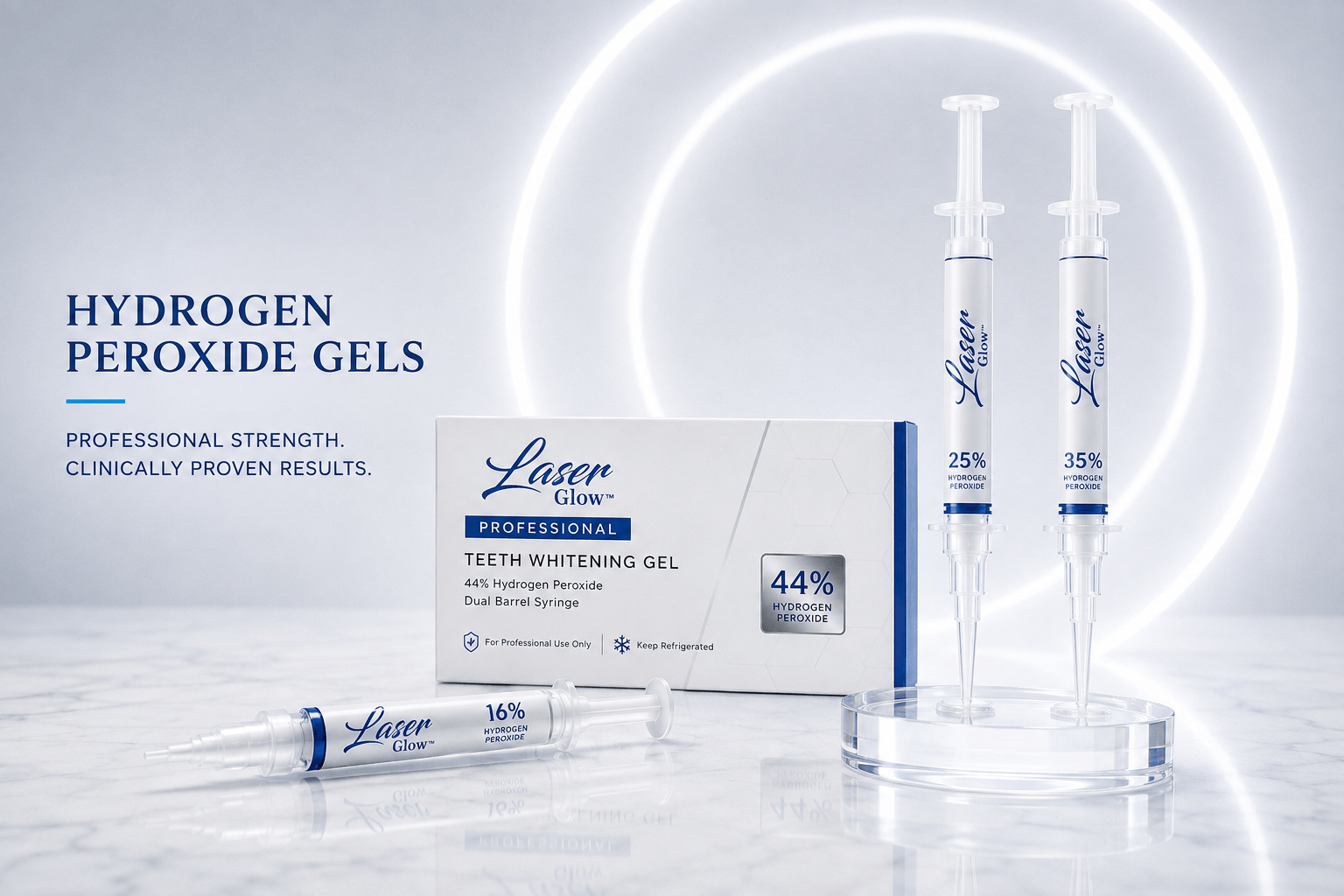
Gingival barrier policy: a gingival barrier is required with every LaserGlow professional hydrogen peroxide gel (16%–44%) and is mandatory at 35% and above. Confirm the rules in your state; see teeth whitening safety and compliance.
Not for every gel or protocol. Peroxide performs the bleaching action, and evidence does not show that light universally improves whitening. If the selected system is designed and labeled for light activation, use compatible professional equipment and follow both manufacturers’ instructions.
A whitening lamp covers the smile zone during gel rounds when the gel’s protocol calls for light. A curing light is a handheld unit that sets light-cure materials such as a gingival barrier or tooth gem composite in seconds. They do different jobs and are not interchangeable.
Most setups need both: the dental LED curing light cures the barrier before any gel goes on.
No. Use light activation only when the gel manufacturer calls for it and identifies compatible specifications. Don’t repurpose a consumer light or a dental curing light for a protocol it wasn’t designed to perform.
LED units use arrays of light-emitting diodes, while laser systems use a focused wavelength and are typically specialized clinical equipment. Marketing terms are used inconsistently, so compare the actual device, protocol, compatibility and operator requirements.
All three are floor-standing professional LED lamps. The entry-level salon machine has dual blue and red LED, a 0–20 minute timer and touchpad control; the touch-screen machine adds adjustable power and timer presets; the clinic lamp adds a 360° articulating arm, dual-arch coverage and three intensity levels.
Compare them all in the teeth whitening machine collection.
For a first whitening service, a bundled kit is usually simpler than sourcing the lamp, gels and consumables separately, and the components are matched to work together from day one.
The professional teeth whitening kit includes the LED machine, a curing light, 25 gel units, gingival barrier, retractors, a shade guide and eyewear.
Compare every LaserGlow whitening light, or start with a complete kit that includes the lamp, curing light, gels and barrier.
Your cart is currently empty.
Not sure where to start?
Try these collections: