Gum protection explained
What is a gingival barrier? It is a protective material placed along the gum line and light-cured into a firm seal before professional whitening, so peroxide gel stays on the teeth and off the gums. Here is how it works, when it is required and what it cannot do on its own.
Short answer: a cured layer that shields gum tissue from whitening gel. LaserGlow uses one with every professional hydrogen peroxide gel, and it is mandatory at 35% and above.
Definition
What is a gingival barrier in professional whitening?
What is a gingival barrier, and why does every professional peroxide service depend on one? Start with what it is and what it is not.
A cured shield for the gum line
A gingival barrier is a protective material placed over the gum tissue that borders the teeth being whitened. It is light-cured or set according to its instructions into a firm layer, so whitening gel applied to the teeth cannot sit directly on the gums.
It is one part of soft-tissue isolation, alongside client screening, retraction, moisture control and careful gel placement. On its own it does not make an unsuitable gel, poor technique or an over-long exposure safe.
LaserGlow policy
Used with every professional HP gel
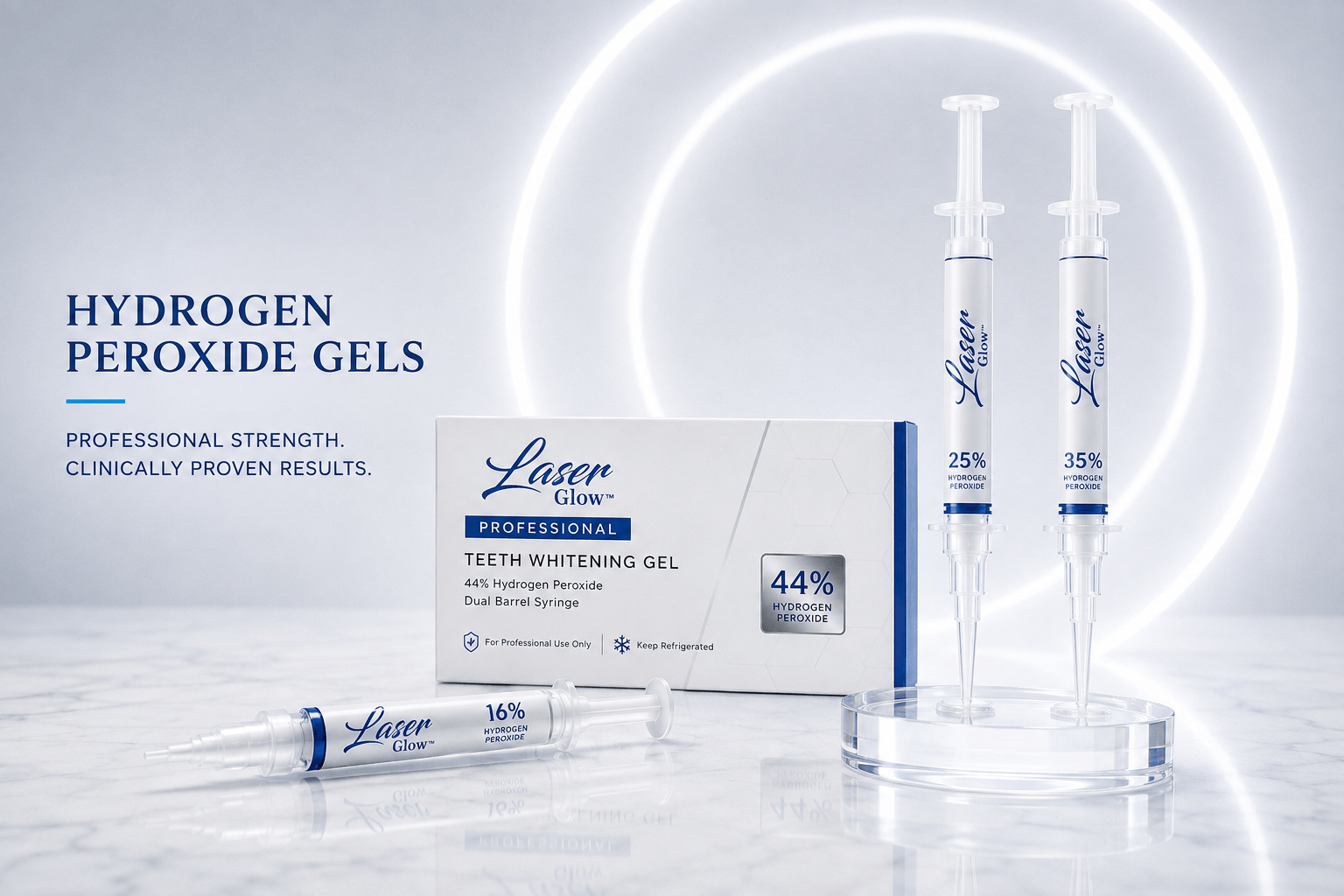
All LaserGlow professional hydrogen peroxide gels, from 16% to 44%, are used with a gingival barrier regardless of strength. At 35%, 36% and 44% it is mandatory every single session.
LaserGlow’s gingival barrier is a light-cured gum protector designed for this step.
Step by step
How a gingival barrier works
- It covers the marginThe material is placed along the gum tissue next to the treatment teeth, covering it continuously with no gaps.
- It cures into a sealA compatible curing light hardens it into a firm layer that hugs the tissue and the tooth margin.
- It keeps gel off the gumsDuring whitening cycles, peroxide on the teeth meets cured barrier instead of gum tissue.
- It comes off after treatmentOnce the gel is removed, the barrier is removed fully and the tissue is checked.
That is how a gingival barrier works in principle. Field preparation, coverage checks, curing and inspection for a specific product are covered step by step in how to apply gingival barrier; always follow the barrier’s own instructions rather than measurements borrowed from another material.
When it applies
When gum protection during teeth whitening is required
| Gel | Barrier | Where to read more |
|---|---|---|
| 16% and 25% HP | Required | 16% HP protocol · 25% HP protocol |
| 35% HP | Mandatory | 35% HP protocol |
| 36% and 44% HP dual-barrel | Mandatory | 36% protocol · 44% protocol |
| PAP+ and other non-HP formulas | Per product instructions | PAP whitening gel professional guide |
Outside LaserGlow’s line, barrier use is set by the whitening product’s instructions, the barrier’s own instructions, your training and local requirements. Peroxide that contacts gum tissue can cause temporary irritation, and a barrier placed poorly can let gel seep underneath. Professional HP gels are for trained providers only; confirm the rules in your state.
Know the limits
What a gingival barrier can’t do on its own
A cured barrier is essential, but it is a single layer in a larger system.
Replace screening
Client assessment and dental referral for pain, damaged teeth or unexplained discoloration still come first.
Replace retraction
Cheeks, lips and moisture still need control. A retractor and a barrier protect different areas.
Excuse excess gel
Overloading gel near the margin defeats the seal. Keep a thin layer on facial surfaces only.
Make longer exposure safe
Contact time still follows the gel’s label. See does leaving whitening gel on longer work.
Treat tooth sensitivity
It protects soft tissue. It does not prevent or treat sensitivity inside the tooth.
Stop all irritation
Protection depends on complete placement, curing, monitoring and the individual client.
If something goes wrong
If whitening gel reaches the gums
Respond, don’t push through
- Stop the cycle at the first report of burning or any visible barrier failure
- Remove or rinse the gel as the product directs
- Assess the area and document what happened
- Refer for dental or medical evaluation if symptoms are significant, persistent or unclear
Understand the white patches
Temporary whitening of the gum tissue usually means peroxide reached an unprotected spot. Why it happens and how providers respond is covered in gums turned white after teeth whitening. Review placement before the next session using the soft tissue isolation teeth whitening protocol.
Who does what
Barrier, retractor and curing light: different jobs
Gingival barrier
Covers the gum tissue next to the teeth so peroxide gel stays off it.
Gingival barrier gel →Cheek retractor
Holds lips and cheeks away from the working field. It does not protect the gum line.
Soft cheek retractor →Curing light
Sets the barrier in seconds per area, before any gel goes on.
Curing light for tooth gems and barrier →Whitening lamp
Used during gel cycles when the gel system calls for it. Not a substitute for a curing light.
Whitening lamp vs curing light →Need all of it at once? The professional teeth whitening kit includes a curing light, gingival barrier and retractors alongside the LED machine and gels. Use as directed.
FAQ
What is a gingival barrier? FAQ
Quick answers about gum protection. Product question? Contact our pro team.
Is a gingival barrier required with LaserGlow whitening gels?
Yes. It is used with every LaserGlow professional hydrogen peroxide gel from 16% to 44%, and it is mandatory at 35% and above.
Follow the gel and barrier instructions for placement, curing and coverage checks.
Is a gingival barrier the same as a rubber dam?
No. They are different isolation systems with different materials, placement and uses.
Can a whitening lamp cure a gingival barrier?
Use only a curing device the barrier instructions identify as compatible. A whitening lamp is not a curing light.
How thick should a gingival barrier be?
Follow the exact product instructions and your training. Don’t copy a measurement from a different barrier material.
Does a gingival barrier prevent all gum irritation?
No. It reduces gel contact with the gums, but protection still depends on complete placement, curing, controlled gel application and monitoring.
Can a gingival barrier treat tooth sensitivity?
No. It protects soft tissue only. For sensitivity after whitening, see how does desensitizing gel work.
Protect the gums before the timer starts
Light-cured gingival barrier, curing lights and retractors for trained providers. Follow product instructions and professional protocols.